
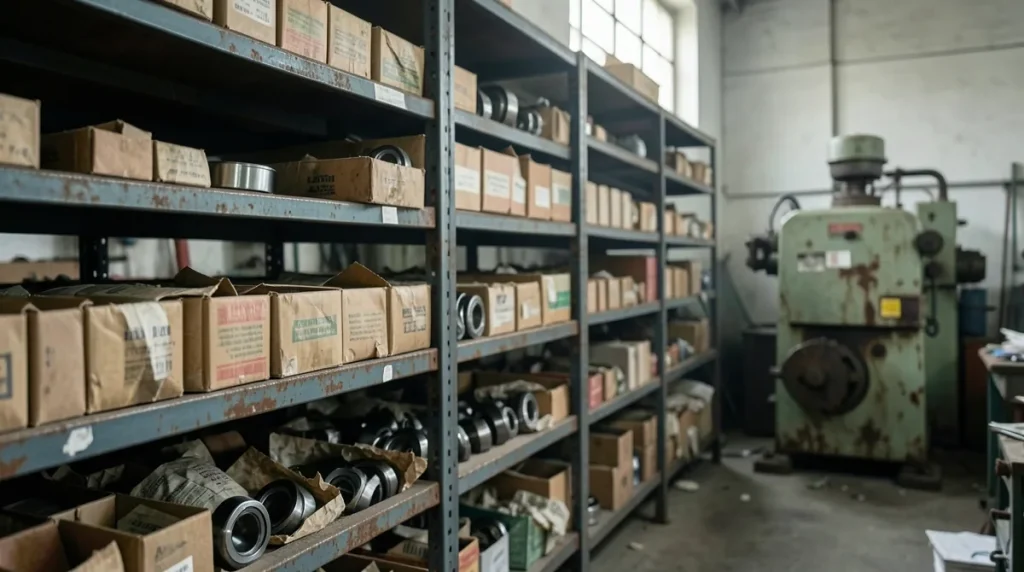
A production line can run for thirty years. The bearings inside it were often catalogued for far less. When a bearing series is discontinued, or an equipment maker stops supplying its own part numbers, the plant that depends on it is one failure away from an unplanned stop with nothing on the shelf.
The Bearing Specialists supplies precision bearings and aerospace bearing tooling from Crawley, West Sussex, to aerospace, motorsport, medical, nuclear, oil and gas, optical, pharmaceutical, and robotics customers across the UK and internationally. This article looks at why obsolete bearing sourcing has become a planning question for UK plant, not only a purchasing one.
Why are UK manufacturers keeping older machines in service?
Many UK manufacturers keep older machines running because output is growing slowly and replacement is hard to justify. ONS figures released on 15 October 2026 show manufacturing output up 0.1% in the three months to August 2026. In that climate, existing plant carries more of the load, and its spare parts matter more.
The Office for National Statistics Index of Production for August 2026 shows total production output down 0.2% over the same three months. Manufacturing rose 1.2% in August alone, but the three-month picture is close to flat. For maintenance teams, flat output tends to mean the same machines, running for longer.
How many UK plants have an obsolescence plan?
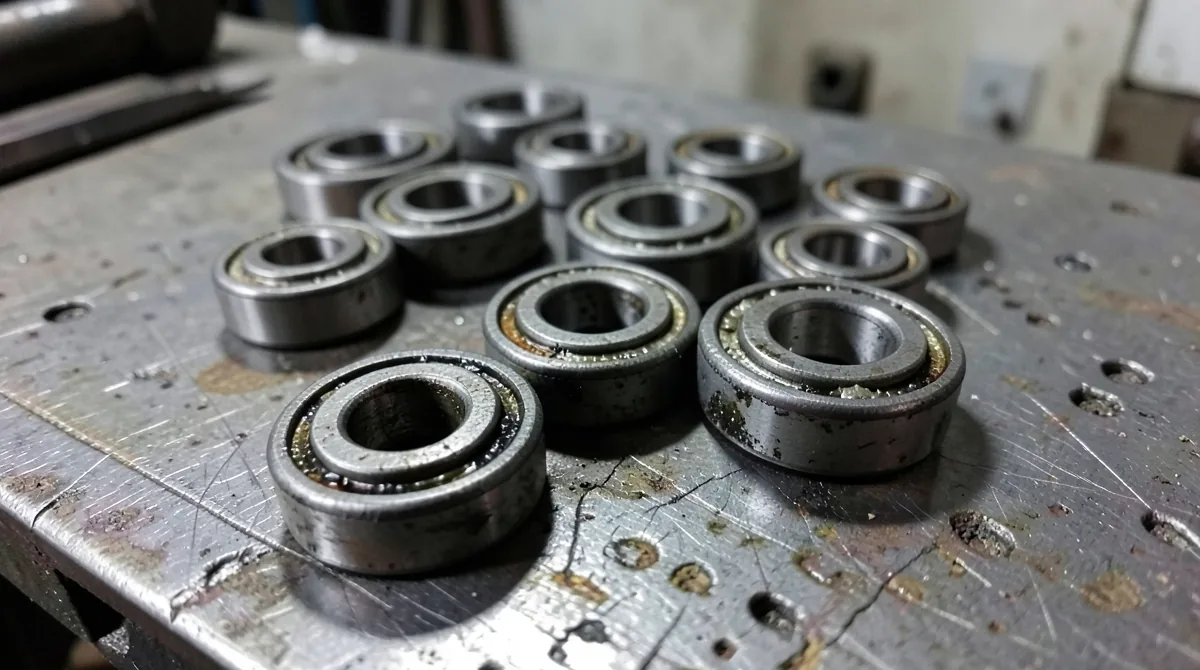
Fewer than many engineers assume. In research reported by the Institution of Mechanical Engineers in September 2018, 62% of UK industry had never carried out an obsolescence audit, and 68% did not know delivery times for spares of critical or obsolete equipment. The figures date from 2018, so treat them as a baseline.
The same IMechE report on obsolescence planning found that almost seven in 10 engineers said more than half of their equipment was over 10 years old. Older equipment is not the problem in itself. Well-built machines often run for decades. The risk sits in the parts list, because nobody tracks the moment a component leaves the catalogue.
What makes a bearing obsolete?
A bearing becomes obsolete when the item a machine needs is no longer available from its original manufacturer. That can mean a discontinued series, a special clearance or cage no longer produced, or an equipment maker’s own part number with no published cross-reference to a standard bearing designation.
Standard sizes are rarely the issue. Most general-purpose ball and roller bearings follow international dimension plans, and current equivalents exist. The difficult cases are the variations: non-standard bores, special internal clearance, bespoke seals, inch-series bearings in metric machines, and bearings built into an assembly under a part number that hides what is inside.
Where do bearings fit in an obsolescence audit?
Bearings belong in the audit alongside drives and controls, ranked by how critical each machine is. For each critical asset, record the full bearing designation including suffixes, note any non-standard features, and flag positions where the original part number no longer appears in a current manufacturer catalogue.
A workable sequence for a site audit:
- Step 1 — Rank assets by the cost of an unplanned stop.
- Step 2 — Record every bearing position on the critical assets, with the full designation and suffix.
- Step 3 — Check each designation against current manufacturer catalogues.
- Step 4 — Flag the gaps: no current equivalent, no part number, or a single remaining source.
- Step 5 — Decide a route for each gap before the bearing fails, not after.
What happens when the part number has gone?
When a bearing has no readable part number, the first job is identification: measuring its boundary dimensions and recording its type, seals, cage, and clearance. Once it is identified, there are three routes to a replacement: a current equivalent, reverse engineering of the original, or redesign of the housing.
Our guide on how to identify a bearing with no part number sets out what to record before contacting a supplier. For the decision that follows, bearing reverse engineering, interchange, and redesign compared explains when each route suits the application.
Frequently Asked Questions About Obsolete Bearing Sourcing
01What is obsolete bearing sourcing?
Obsolete bearing sourcing is the work of finding a replacement for a bearing that is no longer available from its original manufacturer. It covers identifying the bearing, checking for a current equivalent, and, where none exists, reverse engineering the original or redesigning the housing to take a current standard bearing.
02How do I know if a bearing is obsolete?
A bearing is likely obsolete if its designation no longer appears in current manufacturer catalogues, if suppliers quote it as discontinued, or if the equipment maker no longer supplies its own part number. Checking each designation against current catalogues during an obsolescence audit shows which bearing positions are at risk.
03Should we stockpile obsolete bearings?
Holding spares can buy time, but it is not a complete plan. Stored bearings need clean, dry storage, and the grease in sealed bearings ages on the shelf. A common approach is to hold a small number of spares for critical positions while working on a longer-term replacement route.
04What is a last-time buy?
A last-time buy is a final purchase made when a manufacturer announces it will stop producing a part. The quantity is usually based on expected failures over the remaining life of the equipment. It suits parts with predictable usage on assets with a known retirement date.
05Which bearings are most likely to become obsolete?
Non-standard bearings carry the highest risk: special bores, unusual internal clearance, bespoke cages or seals, inch-series sizes in metric machines, and bearings supplied under an equipment maker’s own part number. Standard metric bearings built to international dimension plans usually have current equivalents from several manufacturers.
06How often should an obsolescence audit be repeated?
There is no single required interval. A practical approach is to review critical assets at least once a year, and again whenever a supplier announces a discontinued product, a machine is modified, or a bearing fails without a ready replacement on the shelf.
07Can The Bearing Specialists help with obsolete bearings?
Yes. The Bearing Specialists, based in Crawley, West Sussex, provides specification assistance and sources obsolete and hard-to-find bearings through reverse engineering. Send the bearing’s dimensions, photographs, any markings, and details of the machine it runs in, and our engineering team can review the replacement options.
The Bearing Specialists: Precision Bearings from Crawley, West Sussex
The Bearing Specialists supplies precision bearings and aerospace bearing tooling across the UK and internationally. Our engineering team specifies bearings for high temperature, high speed, cryogenic, and space-constrained applications, and sources obsolete and hard-to-find types through reverse engineering.
Find Out More:
- About Us — Our engineering team, specification assistance, and reverse engineering
- Slewing Rings — Large-diameter bearings found in cranes, turntables, and long-life plant
Have a bearing you cannot source? Send us the details — dimensions, photographs, and where it runs.
Works Cited
- “Index of Production, UK: August 2026.” Office for National Statistics, 15 Oct. 2026, www.ons.gov.uk/economy/economicoutputandproductivity/output/bulletins/indexofproduction/august2026. Accessed 30 Oct. 2026.
- “UK Industry ‘Operating without Safety Net’ Thanks to Lack of Obsolescence Planning.” Institution of Mechanical Engineers, 18 Sept. 2018, www.imeche.org/news/news-article/uk-industry-‘operating-without-safety-net’-thanks-to-lack-of-obsolescence-planning. Accessed 30 Oct. 2026.