
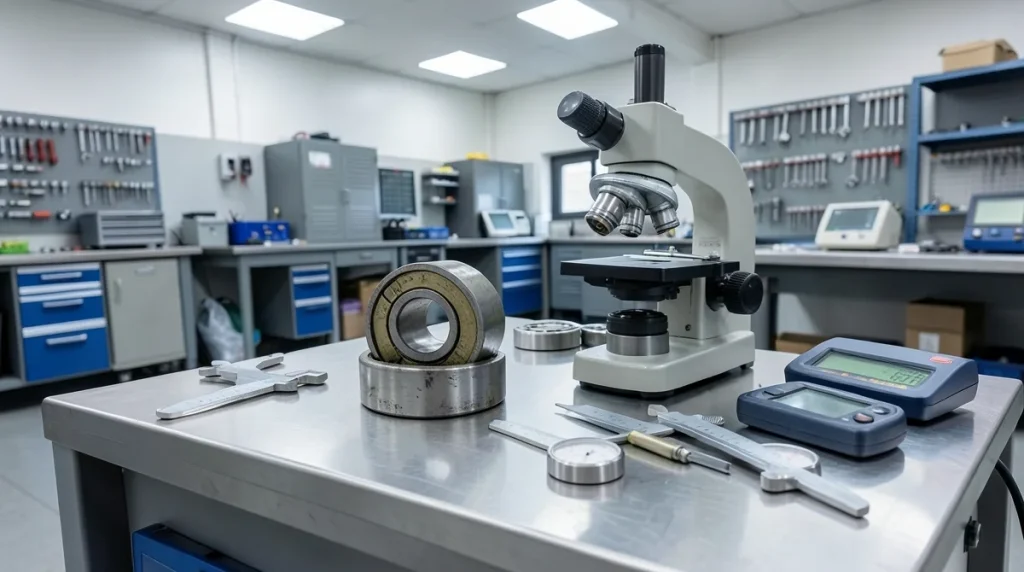
Once an obsolete bearing has been identified, the question changes from “what is it?” to “what replaces it?” This comparison sets interchange, bearing reverse engineering, and redesign side by side. Each solves the problem in a different way, at a different cost, and with a different level of engineering risk.
The Bearing Specialists supplies precision bearings and aerospace bearing tooling from Crawley, West Sussex, to aerospace, motorsport, medical, nuclear, oil and gas, optical, pharmaceutical, and robotics customers across the UK and internationally.
What are the options when a bearing becomes obsolete?
There are three routes. Interchange means fitting a current equivalent from another manufacturer. Reverse engineering means measuring and analysing the original so a replacement can be produced to the same specification. Redesign means changing the shaft, housing, or assembly so a current standard bearing fits.
BS EN IEC 62402:2019, the UK and European standard for obsolescence management, treats obsolescence as the point at which an item still in use moves from available to unavailable from its manufacturer. It asks organisations to select a resolution for each case in advance. For a bearing, these three routes are the resolutions.
When does interchange make sense?
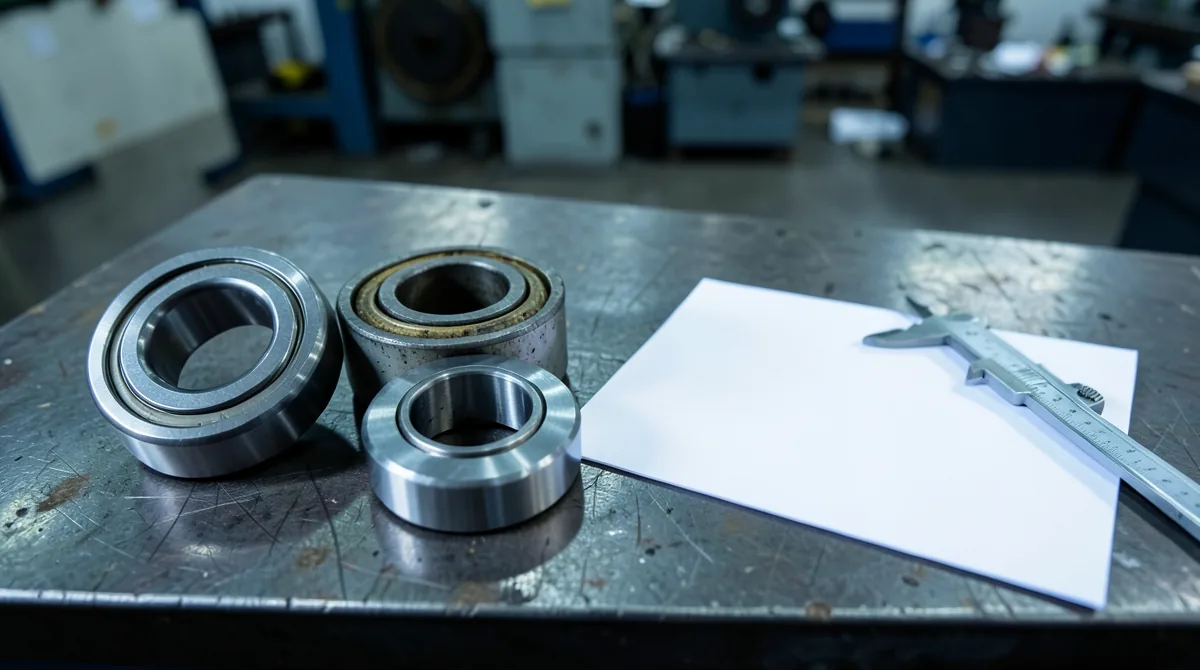
Interchange suits bearings built to standard ISO dimensions, where a current manufacturer produces an equivalent. It is typically the quickest and lowest-cost route. The risk lies in assuming equivalence, because two bearings can share dimensions yet differ in clearance, cage, seals, precision class, or internal geometry.
A sound interchange check compares the full designation, not only the size. Clearance group, cage material, seal type, lubricant, and precision class should each match or be justified. On high-speed or precision positions, small internal differences can change running temperature and noise.
When does bearing reverse engineering make sense?
Bearing reverse engineering suits non-standard bearings with no current equivalent. The original is measured and analysed for dimensions, tolerances, materials, hardness, cage design, and clearance, and a replacement is produced to that specification. It needs a sample, more engineering time, and a higher cost per part than interchange.
This is the route for special bores, bespoke cages, custom seals, and equipment-maker part numbers that hide a non-catalogue bearing. A damaged sample still carries information, so keep failed bearings rather than scrapping them. In aerospace, nuclear, and medical applications, a reverse-engineered part may need approval under the applicable standard or procedure before it is fitted.
When does redesign make sense?
Redesign suits assets with a long remaining life, where the same bearing problem will recur or several positions share it. Changing the shaft or housing to take a current standard bearing ends reliance on one obsolete part, but it carries the highest engineering effort and may trigger requalification of the equipment.
Under the Provision and Use of Work Equipment Regulations, HSE guidance on maintaining work equipment requires equipment to be kept in efficient order and good repair, with the work carried out by competent people. Any redesign should be engineered, documented, and checked against the equipment’s original requirements before it returns to service.
How do the three routes compare?
Interchange is typically the quickest and cheapest but carries equivalence risk. Reverse engineering keeps the original design but needs a sample, time, and a higher unit cost. Redesign takes the most engineering effort but moves the asset onto a current standard bearing. Criticality, quantity, and remaining asset life decide between them.
- Interchange — needs a confirmed designation · low engineering effort · lowest cost per part · main risk: hidden differences in internal design
- Reverse engineering — needs a physical sample · moderate to high effort · higher cost per part, especially in small quantities · main risk: approval requirements in regulated sectors
- Redesign — needs drawings and access to the assembly · highest effort · highest up-front cost · main risk: requalification of the modified equipment
Which route should you choose?
Choose by criticality, quantity, and remaining asset life. A standard bearing in a non-critical position usually goes to interchange. A non-standard bearing in a critical machine with years of service left points to reverse engineering. A recurring problem across several positions on a long-life asset points to redesign.
Identification comes first in every case, so start with how to identify a bearing with no part number. The decision is easier inside a site-wide plan, as our guide to obsolete bearing sourcing explains.
Frequently Asked Questions About Bearing Reverse Engineering
01What is bearing reverse engineering?
Bearing reverse engineering is the process of measuring and analysing an existing bearing to record its full specification, including dimensions, tolerances, materials, hardness, cage design, and internal clearance, so that a replacement can be produced to match. It is used when a bearing is obsolete and no current equivalent exists.
02Does reverse engineering need an undamaged sample?
No. A worn or failed bearing can still be measured and analysed, although heavy damage limits what can be recovered. Keeping failed bearings, along with any drawings, the machine manual, and the shaft and housing dimensions, gives the engineering team more information to work from.
03Is an interchange bearing identical to the original?
Not necessarily. An interchange bearing matches the original’s designation and boundary dimensions, but internal geometry, cage design, and material can differ between manufacturers. In many general-purpose positions this matters little. On high-speed, precision, or safety-critical positions, each difference should be checked before fitting.
04How long does bearing reverse engineering take?
It depends on the bearing’s complexity, the materials involved, any approval requirements, and the quantity needed. Because timescales vary so much between applications, ask for an estimate once the sample and the application details have been reviewed, and build that into the asset’s maintenance plan.
05Is reverse engineering cheaper than redesign?
For a single bearing position, reverse engineering typically costs less up front because the machine itself is unchanged. Redesign carries higher engineering and requalification costs, but it can cost less over time where several positions share the same obsolete bearing or the asset has many years of service left.
06Can reverse-engineered bearings be used in aerospace or nuclear applications?
They can, but only where the applicable standard, procedure, or approving authority accepts the replacement. Regulated sectors often require documented evidence, testing, or formal approval before a non-original part is fitted. Confirm the requirements with the responsible engineering or airworthiness authority before ordering.
07Does The Bearing Specialists offer bearing reverse engineering?
Yes. The Bearing Specialists, based in Crawley, West Sussex, sources obsolete and hard-to-find bearings through reverse engineering, and provides specification assistance to help choose between interchange, reverse engineering, and redesign. Send the bearing’s dimensions, photographs, and application details to start a review.
The Bearing Specialists: Precision Bearings from Crawley, West Sussex
The Bearing Specialists supplies precision bearings and aerospace bearing tooling across the UK and internationally. Our engineering team specifies bearings for high temperature, high speed, cryogenic, and space-constrained applications, and sources obsolete and hard-to-find types through reverse engineering.
Find Out More:
- About Us — Our engineering team, specification assistance, and reverse engineering
- Slewing Rings — Large-diameter bearings found in cranes, turntables, and long-life plant
Weighing up the routes for an obsolete bearing? Send us the details — dimensions, photographs, and where it runs.
Works Cited
- “BS EN IEC 62402:2019 Obsolescence Management.” BSI Knowledge, British Standards Institution, 31 July 2019, knowledge.bsigroup.com/products/obsolescence-management. Accessed 30 Oct. 2026.
- “Maintenance of Work Equipment.” Health and Safety Executive, 19 Nov. 2024, www.hse.gov.uk/work-equipment-machinery/maintenance.htm. Accessed 30 Oct. 2026.
- This article is general engineering information and is not a substitute for the bearing manufacturer’s data sheet, the applicable standard, or an approved maintenance procedure. Confirm specification and installation requirements for your application.