
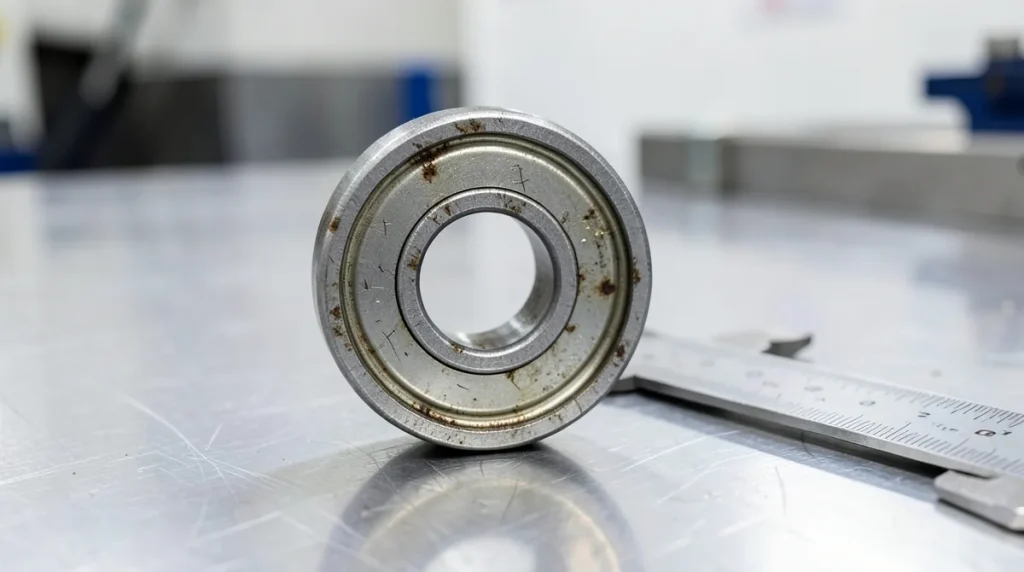
A worn bearing arrives on the bench with its markings rubbed away, or it never carried a standard number at all. The machine is down, the manual is missing, and the equipment maker no longer lists the part. Most rolling bearings can still be identified from what is physically in your hand, and this guide shows how to identify a bearing with no part number.
The Bearing Specialists supplies precision bearings and aerospace bearing tooling from Crawley, West Sussex, to aerospace, motorsport, medical, nuclear, oil and gas, optical, pharmaceutical, and robotics customers across the UK and internationally.
Can you identify a bearing with no part number?
Yes, in most cases. Most rolling bearings are built to international boundary dimension plans, so measuring the bore, outside diameter, and width narrows the field quickly. Recording the bearing type, seals, cage, internal clearance, and any partial markings then narrows it to a single designation or a short list.
Which dimensions should you measure first?
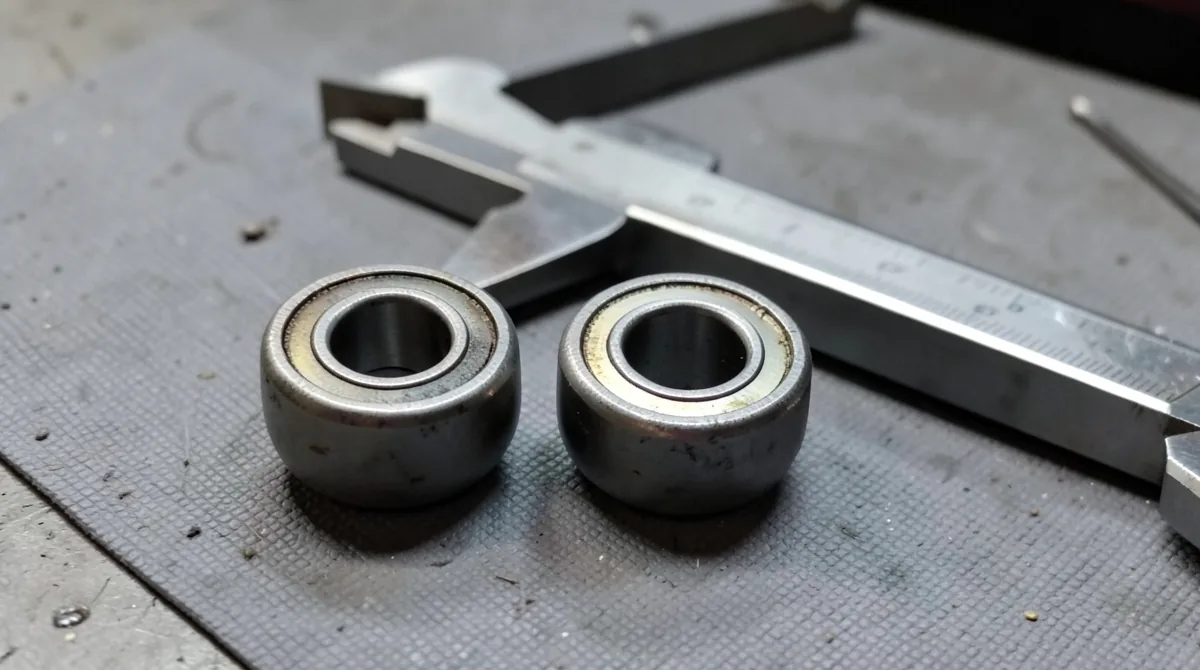
Measure the bore, the outside diameter, and the width, in millimetres, using a calibrated micrometer or vernier. Take each reading at more than one point, because worn bearings measure unevenly. Then compare the three figures against the boundary dimension tables in ISO 15, the international standard for radial bearings.
BS ISO 15:2017, the UK edition of that standard, sets out preferred boundary dimensions for radial bearings across eight diameter series. If the figures fall between metric sizes, convert them to inches. Inch-series bearings still turn up in older and imported machinery, and a 25.4 mm bore is a clue rather than a coincidence.
What else separates two bearings of the same size?
Bearings with identical dimensions can differ in type, seals, cage material, internal clearance, precision class, and material. A sealed deep groove ball bearing and an open angular contact bearing can share a bore, outside diameter, and width yet suit different loads, so each feature needs recording.
- Type — deep groove ball, angular contact, cylindrical roller, needle, tapered roller, or spherical roller
- Seals and shields — rubber seals, metal shields, or open, on one side or both
- Cage — pressed steel, machined brass, or polymer
- Internal clearance — ISO 5753-1 sets radial internal clearance groups, from smaller than normal to larger than normal, and many manufacturers mark the group above normal with a C3 suffix
- Precision class — common on spindle and instrument bearings
- Material — bearing steel, stainless steel, or hybrid ceramic rolling elements
What markings can still help?
Partial markings are worth recording even when incomplete. A fragment of the designation, a suffix such as 2RS or C3, a manufacturer’s logo, or a country of origin can confirm a match. Photograph both faces in good light before cleaning, because solvents and wire brushes can remove faint etching.
What should you send to a bearing supplier?
Send the three boundary dimensions, clear photographs of both faces and the seals, any visible markings, the machine make and model, and the bearing’s position in it. Add running speed, temperature, and load if known, plus the quantity needed. That information is usually enough to start identification.
If no current equivalent exists, the bearing is obsolete. Our guide to obsolete bearing sourcing explains how to plan for that across a site, and bearing reverse engineering, interchange, and redesign compared sets out the three routes to a replacement.
Frequently Asked Questions About Identifying Bearings
01What tools do I need to measure a bearing?
A calibrated outside micrometer or digital vernier calliper covers most bearings, and a bore gauge gives a more accurate bore reading. Clean the bearing and the measuring faces first, take readings at several points, and record each figure in millimetres to at least two decimal places.
02How do I tell a metric bearing from an imperial one?
Convert the measured dimensions to inches by dividing by 25.4. If the figures land on common fractions such as 1/2, 3/4, or 1 inch, the bearing is likely inch-series. If they match whole millimetre values in the ISO dimension tables, it is likely metric.
03What does the C3 suffix mean on a bearing?
C3 is the suffix many manufacturers use for radial internal clearance one group larger than normal, as set out in ISO 5753-1. Larger clearance is often specified where heat or a tight fit reduces clearance in service, so a normal-clearance replacement can run differently in a C3 position.
04What do 2RS and ZZ mean on a bearing?
These suffixes describe how a bearing is closed. 2RS commonly means rubber seals on both sides, and ZZ commonly means metal shields on both sides. Exact designations vary between manufacturers, so confirm the meaning against the relevant manufacturer’s catalogue before ordering a match.
05Can a bearing be identified from a photograph alone?
A photograph helps, but it is rarely enough on its own. Two bearings can look identical yet differ in dimensions, clearance, or precision class. Photographs are most useful alongside the measured bore, outside diameter, and width, plus any markings and details of the machine.
06What if the bearing is too damaged to measure?
A damaged bearing still carries information. Surfaces away from the wear track can give usable readings, and the shaft and housing dimensions confirm the bore and outside diameter. The machine manual and the equipment maker’s drawings can fill the remaining gaps in the specification.
07Can The Bearing Specialists identify a bearing for me?
The Bearing Specialists, based in Crawley, West Sussex, provides specification assistance for bearings without a readable part number. Send the measured dimensions, photographs of both faces and the seals, any markings, and the machine details. Where no current equivalent exists, the team sources obsolete types through reverse engineering.
The Bearing Specialists: Precision Bearings from Crawley, West Sussex
The Bearing Specialists supplies precision bearings and aerospace bearing tooling across the UK and internationally. Our engineering team specifies bearings for high temperature, high speed, cryogenic, and space-constrained applications, and sources obsolete and hard-to-find types through reverse engineering.
Find Out More:
- About Us — Our engineering team, specification assistance, and reverse engineering
- Slewing Rings — Large-diameter bearings found in cranes, turntables, and long-life plant
Have a bearing you cannot identify? Send us the details — dimensions, photographs, and where it runs.
Works Cited
- “BS ISO 15:2017 Rolling Bearings. Radial Bearings. Boundary Dimensions, General Plan.” BSI Knowledge, British Standards Institution, 30 Sept. 2017, knowledge.bsigroup.com/products/rolling-bearings-radial-bearings-boundary-dimensions-general-plan. Accessed 30 Oct. 2026.
- “ISO 5753-1:2009 Rolling Bearings — Internal Clearance — Part 1: Radial Internal Clearance for Radial Bearings.” ISO, International Organization for Standardization, Oct. 2009, www.iso.org/standard/44742.html. Accessed 30 Oct. 2026.
- This article is general engineering information and is not a substitute for the bearing manufacturer’s data sheet, the applicable standard, or an approved maintenance procedure. Confirm specification and installation requirements for your application.