
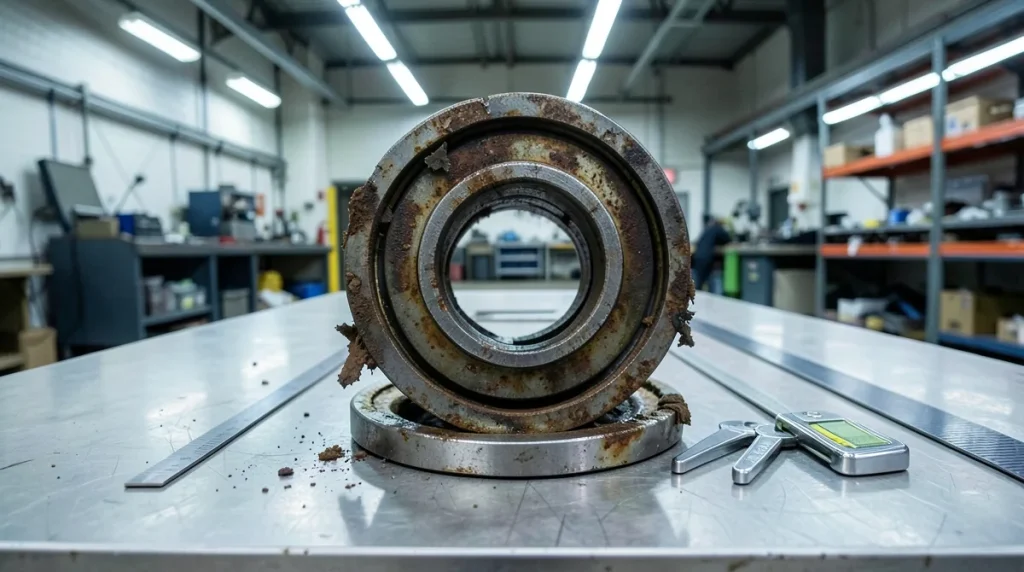
Most slewing ring failures come from overlooked detail rather than the bearing itself. That is an uncomfortable finding, because it means the failure was usually decided before the bearing arrived on site.
The Bearing Specialists supplies precision bearings and aerospace bearing tooling from Crawley, West Sussex, to aerospace, motorsport, medical, nuclear, oil and gas, optical, pharmaceutical, and robotics customers across the UK and internationally. We resolve premature slewing ring failures by specifying better sealing arrangements, selecting materials matched to the real operating environment, and getting the mounting specification right the first time.
Three causes account for the majority of early problems.
Cause One — Galvanic Corrosion Between Mismatched Metals
Put two dissimilar metals in electrical contact with an electrolyte between them and the less noble one corrodes preferentially. Salt water is an excellent electrolyte. Offshore equipment provides it continuously.
Galvanic corrosion between mismatched metals is a principal cause of early slewing ring failure in salt water environments, and it is usually introduced at the interface rather than inside the bearing — the ring, the fasteners, and the mounting structure are frequently not the same alloy family. We screen for this at specification stage, because it is far cheaper to catch on a drawing than on a jack-up vessel. The wider sequence those checks sit inside is set out in our slewing ring specification guide.
Environment severity is classifiable rather than a matter of opinion. ISO 9223:2012 establishes a classification system for the corrosivity of atmospheric environments, identifying the key factors in atmospheric corrosion as the temperature-humidity complex, pollution by sulfur dioxide, and airborne salinity. It defines corrosivity categories by the first-year corrosion rate of standard specimens. ISO last reviewed and confirmed it in 2022, so it remains current as of August 2026.
Two qualifications matter. ISO 9223 addresses atmospheric corrosion, which is a different mechanism from galvanic attack between dissimilar metals — it characterises how aggressive the environment is, not what happens at a bimetallic joint. And the standard states it does not characterise the corrosivity of specific service atmospheres such as those in chemical or metallurgical plant. Use it to frame the environment, then handle the galvanic couple on its own terms.
Cause Two — Poor Mounting Surface Flatness
A slewing ring is only as true as the surface it is bolted to. Mounting surface flatness is a common cause of early problems, and the mechanism is straightforward: an out-of-flat surface distorts the ring as the fasteners are torqued, and a distorted ring does not share load evenly across its raceway.
This is not a marginal effect. ISO 76:2006, the international standard for static load ratings of rolling bearings, states that its calculations do not yield satisfactory results where application conditions cause deviations from a normal load distribution, and it names misalignment as one such condition. A ring distorted by its mounting is operating outside the assumptions behind its own rating.
Installation guidance covering mounting surface preparation and fastener selection exists for this reason. The specification does not end at the bearing.
Cause Three — Inadequate Sealing in Harsh Environments
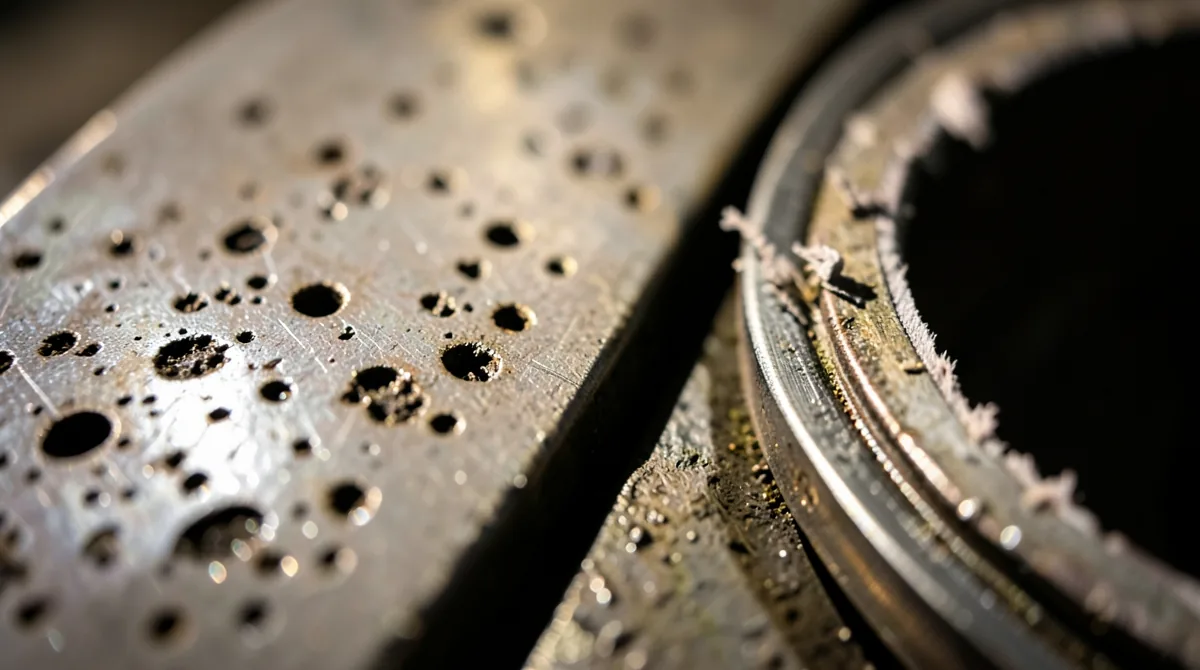
Sealing that suits a workshop does not suit an exposed deck. Inadequate sealing in harsh environments is the third major cause of early failure, and it compounds the first two: a seal that admits salt water delivers the electrolyte that galvanic corrosion needs.
Offshore, desert, and arctic deployment calls for marine grade alloys and corrosion resistant materials, with water resistant greases and improved sealing. Water resistant grease is not a luxury item on marine duty. It is the difference between a lubricant that stays where it was packed and one that emulsifies.
Desert and arctic service fail the same seal for opposite reasons. Fine airborne dust behaves as an abrasive once it reaches the raceway, and a seal chosen for water ingress is not automatically a barrier to particulate. At the cold end, seal materials stiffen, and a lip that no longer conforms to the sealing surface is a lip that is no longer sealing. Specifying against the environment means specifying against the actual temperature range and contaminant, rather than against a general idea of harsh conditions.
Gear configuration interacts with this. An exposed external mesh is one more surface the environment reaches, and one more lubrication point to maintain, which is part of why the choice between internal, external and gearless is covered separately in our article on gear configuration.
Why These Three Cluster Together
None of the three is a bearing defect, and that is the point. Each is a decision made somewhere else — by whoever chose the fastener alloy, machined the mounting face, or accepted a standard seal for a non-standard environment.
They also compound each other. Inadequate sealing admits the electrolyte that galvanic corrosion needs. A distorted ring loads its seals unevenly, which shortens the life of the sealing arrangement that was holding the water out. Each cause makes the next more likely, which is why early failures often present with more than one mechanism visible on the same part and why treating only the most obvious one rarely fixes it.
Which is why we resolve premature failures at the specification stage rather than by fitting a replacement and hoping. When a bearing fails, we ask why, then fix the cause so it does not return. A like-for-like replacement into an unchanged installation produces a like-for-like failure.
There is an uncomfortable implication for procurement here. If the original bearing was specified against a drawing rather than against the site, the replacement will be too unless someone changes how the enquiry is written. Loads, speeds, and environment are the three inputs that matter. Environment is the one most often left off the request.
What This Means for Replacement
If a slewing ring has failed early, the replacement specification should start from the failure rather than from the old part number. Three questions are worth asking before anything is ordered.
What alloys meet at the interface, and are they compatible? What is the flatness of the mounting face as it currently sits, measured rather than assumed? And does the sealing arrangement match the environment the equipment actually operates in, rather than the one it was designed for?
Answer those and the replacement has a reason to outlast the original.
Frequently Asked Questions About Slewing Ring Failure
01What causes most slewing ring bearing failures?
Galvanic corrosion between mismatched metals, poor mounting surface flatness, and inadequate sealing in harsh environments cause the majority of early problems. Most slewing ring failures come from overlooked detail rather than a defect in the bearing itself, which means they are addressable at specification stage.
02How does mounting flatness damage a slewing ring?
An out-of-flat mounting surface distorts the ring as fasteners are torqued, and the distorted ring no longer shares load evenly across its raceway. ISO 76:2006 states its calculations do not hold where conditions cause deviations from normal load distribution, and it names misalignment among them.
03Why is galvanic corrosion worse offshore?
Galvanic corrosion needs two dissimilar metals in contact and an electrolyte between them. Salt water is an effective electrolyte and offshore equipment is exposed to it continuously. Mismatched alloys between the ring, the fasteners, and the mounting structure are a frequent source of the couple.
04Can a failed slewing ring simply be replaced like for like?
Rarely with a good outcome. If the cause was the interface, the mounting face, or the sealing, an identical replacement into an unchanged installation meets the same conditions and fails the same way. Identify the cause first, then specify against it.
05What should I check before ordering a replacement?
Three things. Which alloys meet at the interface and whether they are compatible. The measured flatness of the mounting face as it currently sits. And whether the sealing arrangement matches the environment the equipment operates in rather than the one originally assumed.
The Bearing Specialists: Slewing Rings from Crawley, West Sussex
The Bearing Specialists supplies precision bearings and aerospace bearing tooling across the UK and internationally. We resolve premature slewing ring failures by specifying sealing arrangements and materials matched to the real operating environment, and by getting the mounting specification right the first time.
Our Product Lines Include:
- Slewing Rings — Marine grade alloys and corrosion resistant materials for offshore, desert, and arctic duty
- Oil & Gas — Offshore equipment where sealing and material selection decide service life
Have a failure to diagnose? Tell us your loads, speeds and environment — and what failed.
Works Cited
- International Organization for Standardization. “ISO 9223:2012 — Corrosion of Metals and Alloys: Corrosivity of Atmospheres, Classification, Determination and Estimation.” ISO, www.iso.org/standard/53499.html. Accessed 24 Aug. 2026.
- This article is general engineering information and is not a substitute for the bearing manufacturer’s data sheet, the applicable standard, or an approved maintenance procedure. Confirm specification and installation requirements for your application.