
Most bearing selection starts with a bore diameter. Slewing ring selection does not. It starts with a moment load, and if that number is wrong everything downstream is wrong with it.
The Bearing Specialists supplies precision bearings and aerospace bearing tooling from Crawley, West Sussex, to aerospace, motorsport, medical, nuclear, oil and gas, optical, pharmaceutical, and robotics customers across the UK and internationally. We supply precision slewing ring bearings across the UK for defence, medical, renewable energy, and industrial automation work, and we start every project with your real operating conditions rather than a catalogue page.
This guide covers the five decisions that make up a slewing ring specification.
What a Slewing Ring Actually Does
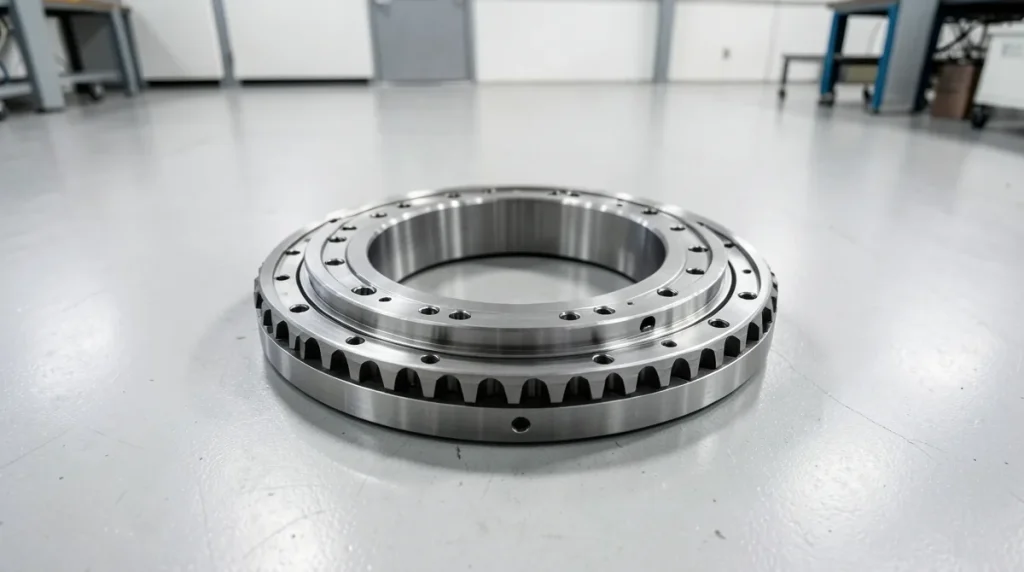
Slewing rings are large diameter bearings that carry radial, axial, and moment loads in a single unit. They are often fitted with internal or external gear teeth, and they support rotating equipment such as cranes, excavators, wind turbines, and radar systems.
The point of the component is consolidation. One slewing ring replaces a complex multi bearing assembly with a single compact, high capacity unit. That is why the specification carries more weight than a standard bearing selection: there is no second bearing sharing the load if the first one is under-specified.
Decision One — The Load Case
Large rotating equipment takes serious loads from several directions at once, and the moment load is usually the one that decides the bearing. A crane boom, a radar mast, or a turbine nacelle applies an overturning couple that a standard bearing arrangement would need two widely spaced bearings to resist.
Specification starts with load data, rotation speeds, and environmental factors. Required capacity follows from those, with sensible safety margins applied. The safety margin is not padding. ISO 76:2006, the international standard for rolling bearing static load ratings, gives guidelines for static safety factors to be applied in heavily loaded applications, and it notes that its calculations do not yield satisfactory results where application conditions cause deviations from a normal load distribution — misalignment among them. A slewing ring on an imperfect mounting surface is exactly that case, and it is one of the three mechanisms covered in our article on why slewing ring bearings fail.
The 2006 edition remains current as of August 2026, though ISO moved it to revision stage in May 2026, so check for a newer edition before citing it in a specification.
Decision Two — Rows and Contact Type
Standard and custom rings run from 200mm to 5000mm and beyond, in single row, double row, triple row, and crossed roller configurations. Multi row assemblies raise load capacity without increasing diameter, which matters when the envelope is fixed by the structure rather than by the bearing.
Three contact configurations cover most requirements:
Radial contact handles perpendicular loads efficiently in compact spaces.
Angular contact manages combined radial and axial forces, and pairing increases load capacity and moment load resistance.
Four point contact provides bidirectional axial load capability within minimal cross sectional dimensions.
Loading conditions decide which configuration applies. Where the envelope is genuinely tight, thin section options fit installation spaces that a conventional ring will not.
Crossed roller construction deserves a mention of its own. Rollers arranged alternately at right angles let a single row take radial, axial, and moment load in both directions, which suits applications where rotation is slow and positioning accuracy matters more than speed. Multi row construction takes the opposite approach, stacking capacity into the same diameter where the load is the problem and the envelope is fixed.
Decision Three — Gearing
Gearing can be internal, external, or gearless, with teeth integrated directly into the bearing ring to cut assembly complexity. The choice follows your drive layout rather than the other way round, and it is worth settling early because it constrains the surrounding structure.
The trade-offs between the three are covered in detail in our article on choosing slewing ring gear configuration.
Decision Four — Materials and Environment
Environment drives material selection more than load does.
Offshore, desert, and arctic deployment calls for marine grade alloys and corrosion resistant materials, with water resistant greases and improved sealing. MRI scanners and other precision medical imaging equipment call for non magnetic stainless steels and ceramic elements, to keep magnetic interference low. Pharmaceutical, food processing, and clean room environments call for FDA compliant materials and food grade lubricants.
Where operating temperatures run high, the specification moves to high temperature bearings with materials and lubricants matched to the duty.
Decision Five — Mounting and Installation
This is the decision most often left to the installer, and it is the one that most often costs money later.
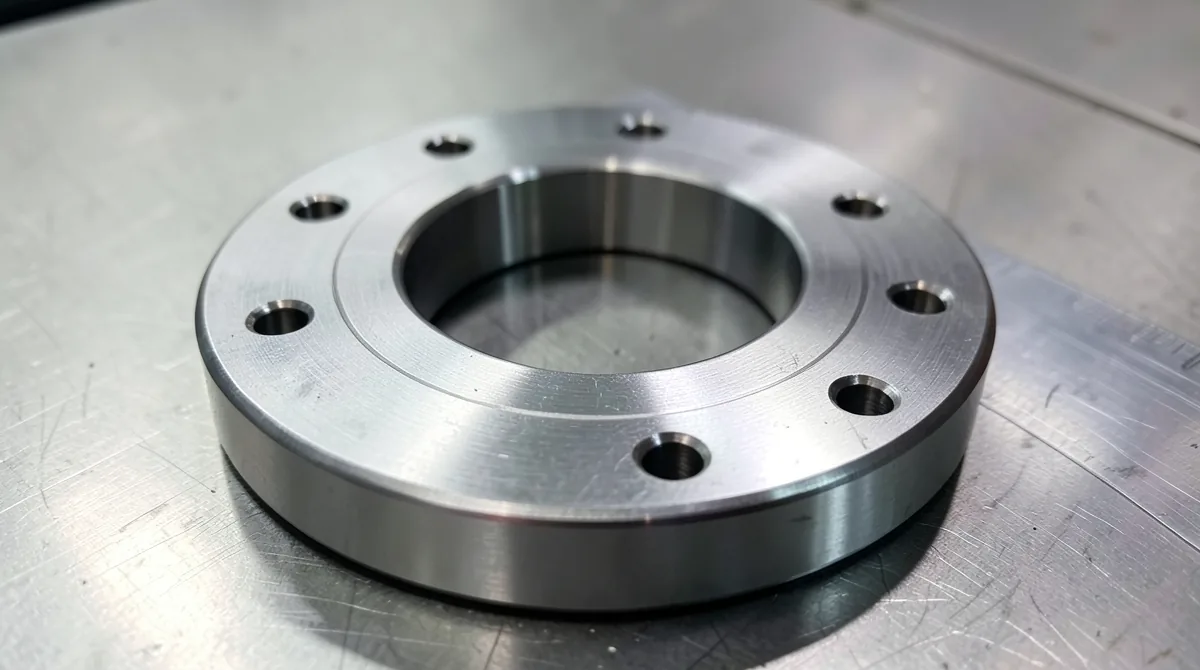
We provide installation guidance covering mounting surface preparation and fastener selection. Poor mounting surface flatness distorts the ring and changes how load distributes across the raceway, which is the same deviation from normal load distribution that ISO 76 warns takes the calculation outside its stated scope. Getting the mounting specification right the first time is cheaper than diagnosing it afterwards.
Which Industries Use Slewing Rings
Slewing ring bearings support demanding applications across defence, medical, renewable energy, and heavy industry. Common uses include radar and turret systems, MRI scanners and diagnostic imaging, cranes and excavators with constrained installation spaces, wind turbine yaw and pitch systems in exposed conditions, and manufacturing systems inside clean room environments.
The common thread is that the bearing is structural. It is not a component inside a machine so much as the joint the machine rotates on. When it goes, the equipment does not run degraded. It stops.
That also explains why the diameter range runs so wide. A surgical imaging gantry and a crane slew ring are the same class of component solving the same problem at opposite ends of the scale, which is why the range runs from 200mm through to beyond 5000mm rather than within a narrow band. The specification process is identical either way. Only the numbers change.
Standards and Traceability
Slewing ring work sits across several standards families — ISO, DIN, ABMA, and AGMA all carry relevant material — and traceability on materials and manufacturing is what lets a specification be audited after the fact rather than taken on trust.
That traceability matters most when something has gone wrong. A failure that cannot be traced to a material batch or a manufacturing record is a failure that cannot be designed out of the next one.
Frequently Asked Questions About Slewing Ring Specification
01What load types does a slewing ring have to carry?
Radial, axial, and moment loads, all at once and in a single unit. The moment load usually decides the specification, because the overturning couple from a boom, a mast, or a nacelle is what a conventional two-bearing arrangement would be built to resist across a wide span.
02Why does row configuration matter when the diameter is fixed?
Multi row construction raises load capacity without increasing diameter. Where the envelope is set by the surrounding structure rather than by the bearing, adding rows is the route to more capacity. Crossed roller construction takes a different path, handling both directions within a single row.
03What is four point contact construction used for?
Four point contact provides bidirectional axial load capability within minimal cross sectional dimensions, which suits applications where axial load runs both ways and the cross section is tight. Radial contact handles perpendicular loads in compact spaces. Angular contact manages combined radial and axial forces.
04Does a slewing ring need a safety factor when sized?
Yes. ISO 76:2006 gives guidelines for static safety factors in heavily loaded applications, and it notes that its calculations do not hold where conditions cause deviations from normal load distribution. A ring distorted by an out-of-flat mounting face sits in exactly that category.
05What information does a supplier need to quote a slewing ring?
Loads, rotation speeds, and the operating environment, along with the installation envelope and the drive layout. Environment is the input most often missing from an enquiry, and it decides material grade, sealing arrangement, and lubricant. A diameter on its own is not enough to quote against.
The Bearing Specialists: Slewing Rings from Crawley, West Sussex
The Bearing Specialists supplies precision bearings and aerospace bearing tooling across the UK and internationally. Our engineering team specifies slewing rings for defence, medical, renewable energy, and industrial automation work, starting from your real load data, rotation speeds, and operating environment.
Our Product Lines Include:
- Slewing Rings — 200mm to 5000mm and beyond, single through triple row and crossed roller
- Thin Section Bearings — Where the installation envelope is fixed and tight
Have an application to specify? Tell us your loads, speeds and environment — and we will specify the right bearing the first time.
Works Cited
- International Organization for Standardization. “ISO 76:2006 — Rolling Bearings: Static Load Ratings.” ISO, www.iso.org/standard/38101.html. Accessed 24 Aug. 2026.
- This article is general engineering information and is not a substitute for the bearing manufacturer’s data sheet, the applicable standard, or an approved maintenance procedure. Confirm specification and installation requirements for your application.