

A bearing that runs without complaint at 20°C can lock solid at −196°C. Nothing about the load has changed, and nothing about the speed has changed. The metal has simply shrunk, and it has not shrunk evenly.
That single fact governs every decision in a cryogenic bearing specification. The Bearing Specialists supplies precision bearings and aerospace bearing tooling from Crawley, West Sussex, to aerospace, motorsport, medical, nuclear, oil and gas, optical, pharmaceutical, and robotics customers across the UK and internationally. Our engineering team works on cryogenic bearings and precision bearing solutions across liquefied gas handling, nuclear, motorsport, and clean room applications, backed by 12 years of combined engineering experience — seven of those years dedicated solely to bearing technology.
This guide sets out what a cryogenic bearing is, and how the specification changes across LNG, liquid nitrogen, liquid oxygen, and hydrogen service.
What a Cryogenic Bearing Actually Is
Cryogenic bearings are precision-engineered assemblies designed to hold stability and reliable output at temperatures as low as −196°C. They depend on purpose-selected materials — silicon nitride ceramic balls, 440C stainless steel races, and PTFE-based dry lubricants — to function where standard bearings fail.
The core function has not changed. A bearing reduces friction and supports load. What changes is that the function must hold under conditions that destroy standard assemblies within hours, so every element of the assembly is chosen against the temperature rather than against a catalogue page.
Why Thermal Expansion Governs the Specification
At cryogenic temperatures the coefficient of thermal expansion becomes the critical variable. Steel components contract at different rates. That creates interference fits that lock up, or clearances that open until the ball loses contact with the race.
Hybrid designs address this by pairing silicon nitride ceramic balls with 440C stainless steel races. Silicon nitride expands at a much lower rate than steel, which is why it works as the rolling element in this pairing. Bearing geometry then stays consistent from ambient down to −196°C.
Differential thermal expansion is not a bearing-specific problem. It drives failures across cryogenic plant generally, from pipework to vessel jackets, wherever two joined components cool at different rates and the joint carries the difference. Inside a bearing the scale is smaller and the principle is the same.
If you want the failure modes broken down individually, our companion article on why bearings fail at cryogenic temperatures covers each one in sequence.
Specifying for LNG and Industrial Gas Handling
LNG pump systems operate near −162°C. We have supplied hybrid bearing designs into these systems, where controlled fitting steps and precise material selection carried the specification. Across every project we have supported in cryogenic service, we have recorded zero bearing failures.
What makes LNG demanding is not the temperature alone. A bearing seizure in LNG or industrial gas handling triggers pressure problems, unplanned shutdowns, and costly safety work. The bearing is a small component sitting upstream of a very large consequence, which is why the specification work happens before the order rather than after the failure.
Specifying for Liquid Nitrogen and Liquid Oxygen
Liquid nitrogen reaches −196°C, the floor of the range. Every material in the assembly is checked against that figure rather than against a nominal low-temperature rating.
Liquid oxygen adds a second constraint on top of the first. Oxygen compatibility becomes a screening criterion in its own right, and all parts are screened for LOX compatibility before any specification is confirmed. The reason is direct: contamination from failed cage materials introduces fire risk in liquid oxygen systems. A cage that merely wears in LNG service can behave very differently in a LOX environment.
Specifying for Hydrogen Systems
Hydrogen systems carry serious safety and financial implications, so the material screening extends further again. Hydrogen embrittlement screening covers all bearing materials, cage parts, and lubricants as a standard step in our specification process.
Hydrogen embrittlement of steel is a recognised enough problem to have its own test methodology. ISO 11114-4:2017 specifies test methods for qualifying steels as resistant to hydrogen embrittlement, along with evaluation criteria for the results. Its scope is seamless steel gas cylinders rather than bearings, so it is the screening principle that carries across rather than the standard itself. Ask what method was used and what the result was.
Cages and Lubrication at −196°C
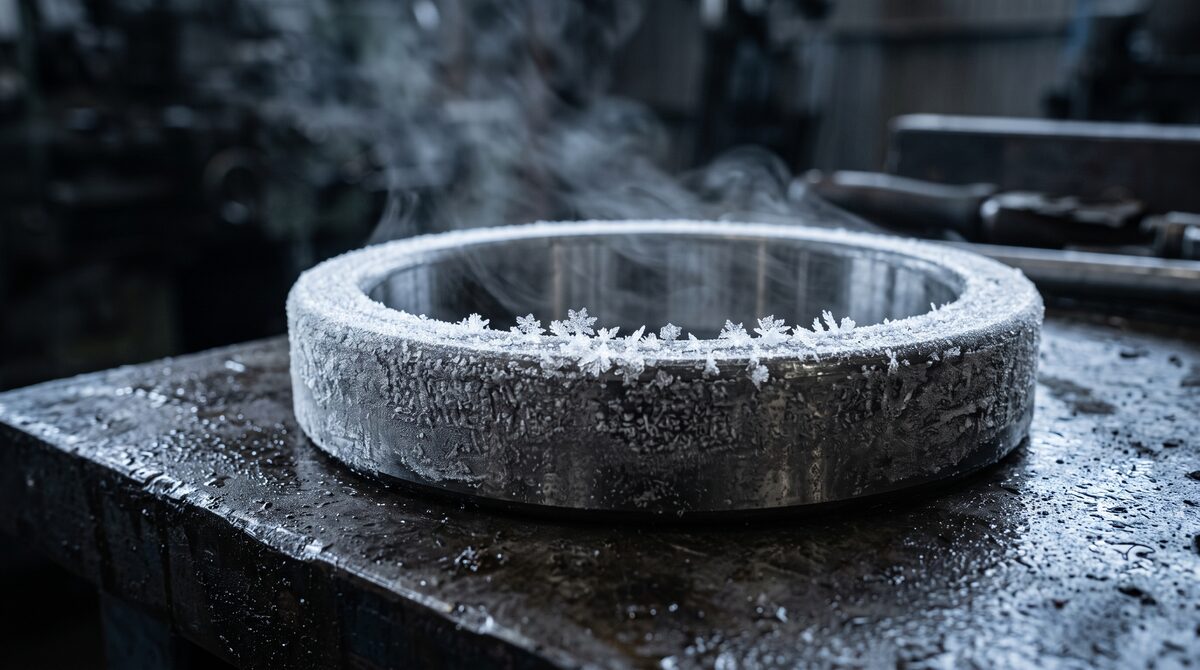
Two elements fail before the races do.
Cages. Standard cage designs fracture under combined thermal contraction and high rotational speed. Our bespoke riveted cage designs address that at the engineering level. In one high-speed industrial pump application, a two-piece riveted cage design for a deep groove ball bearing removed premature cage failure caused by thermal expansion and high-speed instability, and extended bearing life by 300%.
Lubrication. Standard greases lose viscosity, migrate, and freeze at low temperatures. Dry lubricant systems replace them entirely — PTFE-based coatings, PEEK composites, and solid lubricant coatings. These hold a consistent low-friction interface down to −196°C without the contamination or migration risks of oil-based alternatives. The same systems suit high-vacuum, clean room, and food-grade environments where standard greases are unsuitable or banned.
Testing Before the Bearing Reaches the System
In-house cryogenic testing uses liquid nitrogen test facilities to verify bearing output before use in safety-critical systems. Testing confirms stability, lubrication, and load capacity at real operating temperatures rather than at ambient with a calculation attached.
For safety-critical systems, pre-fitting checks earn their cost quickly, because a field failure carries costs far exceeding the price of early testing.
Installation: The Step That Fails Most Often
Standard fitting procedures cause immediate failure in cryogenic service. Thermal shock during initial cool-down creates expansion gaps that standard fitting steps cannot manage.
Our protocols include pre-cooling sequences, controlled temperature ramp rates, and purpose-built guidance written for the specific assembly. On-site supervision and commissioning support are available for safety-critical applications. Fitting is part of the specification, not a separate activity that happens afterwards.
Nuclear, Clean Room and High-Speed Applications
The same thinking extends beyond liquefied gas. Nuclear and clean room environments bring their own requirements: material traceability, full records, and ultra-low particle output. Where a non-magnetic assembly is required, say so at enquiry stage, because it constrains the race material rather than the rolling element.
For pump systems that need combined radial and axial load support, angular contact designs are often specified alongside cryogenic bearings. Where the choice between hybrid ceramic and all-steel construction is the open question, our article comparing hybrid ceramic and steel bearings at cryogenic temperatures sets the two side by side.
Frequently Asked Questions About Cryogenic Bearings
01What is the operating temperature range for cryogenic bearings?
Our cryogenic bearing solutions are built for temperatures from −196°C up to ambient operating conditions. That range covers LNG, LN2, and LOX applications throughout. Each design is checked against its specific target temperature before use, so stability and lubrication output hold across the intended service life.
02What materials are used in cryogenic bearing assemblies?
Silicon nitride ceramic balls paired with 440C stainless steel races form the hybrid design used for extreme-temperature applications. Cage materials are typically PTFE composites or PEEK. Lubrication relies on PTFE-based dry lubricants and solid lubricant coatings. Together these hold stability and low friction from ambient down to −196°C.
03Can cryogenic bearings be tested before installation?
Yes. Our in-house cryogenic test facilities use liquid nitrogen to check bearing output before fitting. Testing confirms stability, lubrication, and load capacity under real operating temperatures. For safety-critical systems, pre-fitting checks matter, because a field failure carries costs far exceeding the price of early testing.
04Do cryogenic bearing installations need special procedures?
Yes. Standard fitting procedures cause immediate failure in cryogenic service. Our protocols include pre-cooling sequences, controlled temperature ramp rates, and purpose-built guidance that account for thermal shock during initial cool-down. On-site supervision and commissioning support are available for all safety-critical applications.
05Why does liquid oxygen service need extra screening?
Liquid oxygen adds oxygen compatibility as a constraint on top of the temperature requirement. All parts are screened for LOX compatibility before any specification is confirmed, because contamination from failed cage materials introduces fire risk in liquid oxygen systems. The screening covers cages and lubricants as well as races.
The Bearing Specialists: Cryogenic Bearings from Crawley, West Sussex
The Bearing Specialists supplies precision bearings and aerospace bearing tooling across the UK and internationally. Our engineering team specifies bearings for cryogenic, high temperature, high speed, and space-constrained applications, and sources obsolete and hard-to-find types through reverse engineering. Our team holds ISO 9001:2015 and AS9120D:2016 quality system certifications, with an industry partner network covering heat treatment and lubrication.
Our Product Lines Include:
- Cryogenic Bearings — For LNG, LN2, LOX, and hydrogen pump systems down to −196°C
- Nuclear — Non-magnetic materials, full records, and ultra-low particle output
Have an application to specify?
Send us the details — load, speed, temperature, and envelope.
This article is general engineering information and is not a substitute for the bearing manufacturer’s data sheet, the applicable standard, or an approved maintenance procedure. Confirm specification and installation requirements for your application.
Works Cited
- International Organization for Standardization. “ISO 11114-4:2017 — Transportable Gas Cylinders: Compatibility of Cylinder and Valve Materials with Gas Contents, Part 4: Test Methods for Selecting Steels Resistant to Hydrogen Embrittlement.” ISO, www.iso.org/standard/64587.html. Accessed 24 Aug. 2026.