

Two rolling elements sit on the bench. One is 440C stainless steel. One is silicon nitride ceramic. At room temperature the choice between them is a question of cost and speed. At −196°C it is a question of whether the assembly turns at all.
The Bearing Specialists supplies precision bearings and aerospace bearing tooling from Crawley, West Sussex, to aerospace, motorsport, medical, nuclear, oil and gas, optical, pharmaceutical, and robotics customers across the UK and internationally. This article compares the two constructions on the criteria that decide the specification: thermal behaviour, speed capability, friction, corrosion resistance, and electrical isolation.
We compare materials and constructions here, not suppliers.
The Comparison in One Paragraph
An all-steel bearing has matched materials throughout, which sounds like an advantage and is not one at cryogenic temperatures. A hybrid bearing pairs silicon nitride ceramic balls with 440C stainless steel races, deliberately mismatching the materials so that the geometry holds as the assembly cools. The hybrid wins on thermal stability, speed, friction, and electrical isolation. The all-steel design keeps its place where the temperature range is narrow and the cost case is tight.
Thermal Contraction: Where All-Steel Construction Struggles
Steel components contract at different rates as temperature falls. In an all-steel assembly, that produces two outcomes and neither is good. Interference fits tighten past design tolerance and the bearing locks. Or clearances open until the ball loses contact with the race.
Silicon nitride expands at a much lower rate than steel. Pairing a low-expansion ball with a 440C stainless steel race means the internal geometry stays consistent from ambient down to −196°C. The mismatch is the point. Matching the materials matches their contraction, and matched contraction is what closes the clearance.
This is the single strongest argument for hybrid construction in cryogenic service, and it is a geometry argument rather than a materials-marketing one.
What 440C Stainless Steel Contributes
440C earns its place on the race side. It is a high-carbon martensitic stainless steel, which is what allows it to be heat treated to the hardness a raceway needs while carrying the corrosion resistance that liquefied gas and clean room environments demand.
One property worth stating plainly, because it decides some specifications on its own: 440C is martensitic, and martensitic stainless steels are magnetic. Where an application genuinely requires a non-magnetic assembly, that requirement has to be met through the material set as a whole rather than assumed from the race material. Raise it early, because it narrows the options.
The race is also where load is distributed across a larger contact area, so the material demand differs from the demand on the rolling element. Keeping steel races and changing the balls is a targeted change rather than a wholesale one.
What Silicon Nitride Contributes
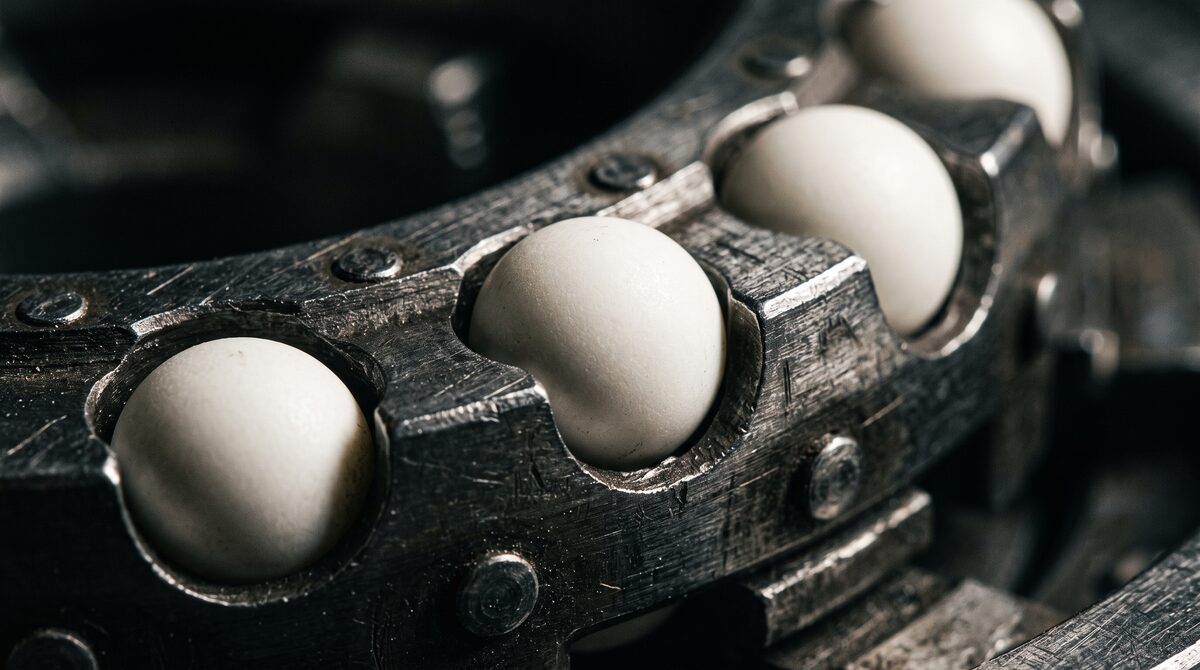
Silicon nitride is a defined engineering material with its own international standard rather than a generic ceramic. ISO 26602:2017 specifies requirements for preprocessed silicon nitride materials for rolling bearing balls and rollers, classifying them into three categories by their physical and mechanical properties and microstructure. ISO last reviewed and confirmed it in 2023, so it remains the current edition as of August 2026. Specifying “ceramic” is not a specification. Specifying against ISO 26602 is.
In service, hybrid silicon nitride ceramic bearings are chosen for speed capability, low friction, corrosion resistance, and electrical isolation across high-performance industrial and motorsport applications. In cryogenic service the thermal argument leads, and these properties come with it.
Load Ratings Work Differently for Hybrids
A hybrid bearing is not an all-steel bearing with different balls fitted, and it is not rated as one. ISO 20056-2:2017 sets out methods for calculating static load ratings for hybrid bearings that combine steel rings with a full set of silicon nitride rolling elements, and it references ISO 26602 together with ISO 3290-2 for the balls themselves.
The practical consequence for a design engineer is that a hybrid and an all-steel bearing of the same nominal size are not interchangeable on a drawing without checking the rating basis. Take the figures from the bearing manufacturer’s data sheet for the specific series, calculated for your stated conditions.
Cages and Lubricants Follow the Rolling Element
Choosing the rolling element does not finish the specification. Standard cage designs fracture under combined thermal contraction and high rotational speed, whichever ball material sits inside them. Cage materials for cryogenic work are typically PTFE composites or PEEK, and bespoke riveted designs address cage instability directly.
Lubrication follows the same logic. Standard greases lose viscosity, migrate, and freeze at low temperatures, so dry lubricant systems replace them — PTFE-based coatings, PEEK composites, and solid lubricant coatings that hold a consistent low-friction interface down to −196°C. A hybrid ball set running in a frozen grease is still a failed bearing.
Where the Choice Bites Hardest
Some applications tolerate a marginal decision. These do not.
High-speed pump systems. Speed and thermal contraction load the cage simultaneously, and the rolling element choice sets how much of that load the cage has to absorb. Where the pump also needs combined radial and axial load support, angular contact designs are specified alongside the cryogenic bearing rather than in place of it.
Motorsport. Speed capability and low friction carry the argument here, and hybrid silicon nitride designs are used across high-performance industrial and motorsport applications for exactly those properties.
Clean room production. Particle output becomes a specification line rather than a side effect. Designs built from 440C stainless steel, silicon nitride ceramics, and PTFE composites are chosen against corrosion resistance, non-magnetic behaviour, and ultra-low particle output together.
Electrical isolation. Ceramic rolling elements do not conduct. Where stray current through a bearing is a concern, the hybrid construction addresses it as a property of the material rather than as an added component.
Where All-Steel Still Makes Sense
Hybrid construction is not the answer to every low-temperature application. Where the operating range is narrow, the speed is modest, and the temperature never approaches the extremes, an all-steel assembly with the correct lubricant and clearance class remains a reasonable choice.
The decision point is the span between installation temperature and operating temperature, not the operating temperature alone. A bearing that sits at a steady moderate low temperature is a different problem from one that cycles between ambient and −196°C. Our article on why bearings fail at cryogenic temperatures takes that cycling problem apart in detail.
How the Decision Gets Made in Practice
Material selection, precision class, cage design, and lubrication strategy are engineered together rather than picked from a catalogue in sequence. Each specification we work on begins with root cause analysis, material science review, and purpose-built engineering.
Once the design is set, in-house cryogenic testing with liquid nitrogen verifies output before the bearing goes into a safety-critical system. The full specification route across LNG, LN2, LOX, and hydrogen service is set out in our cryogenic bearings specification guide.
Frequently Asked Questions About Hybrid Ceramic and Steel Bearings
01Why do hybrid bearings hold geometry better at low temperatures?
Silicon nitride ceramic balls expand and contract at a much lower rate than steel. Pairing them with 440C stainless steel races holds internal bearing geometry consistent from ambient down to −196°C, which addresses the interference and clearance failures that mismatched contraction produces in all-steel assemblies.
02Is a hybrid bearing a direct replacement for an all-steel bearing?
Not automatically. Hybrid bearings are rated on a different basis. ISO 20056-2:2017 sets out static load rating calculation for hybrid bearings combining steel rings with silicon nitride rolling elements. Check the rating basis on the bearing manufacturer’s data sheet for the specific series before substituting on a drawing.
03What does specifying against ISO 26602 achieve?
ISO 26602:2017 specifies requirements for preprocessed silicon nitride materials for rolling bearing balls and rollers, classifying materials into three categories by physical and mechanical properties and microstructure. Referencing it turns a vague request for a ceramic ball into a defined material requirement that a supplier can quote against.
04Do hybrid bearings still need dry lubrication?
Yes. The rolling element material does not change the lubricant problem. Standard greases lose viscosity, migrate, and freeze at low temperatures whatever the balls are made from. PTFE-based coatings, PEEK composites, and solid lubricant coatings hold a consistent low-friction interface down to −196°C.
05Which construction suits nuclear and clean room work?
These environments call for corrosion resistance, ultra-low particle output, and full material records. Treat magnetic signature separately: 440C is a martensitic stainless steel and martensitic grades are magnetic, so a genuinely non-magnetic assembly needs that requirement stated at enquiry stage.
The Bearing Specialists: Precision Bearings from Crawley, West Sussex
The Bearing Specialists supplies precision bearings and aerospace bearing tooling across the UK and internationally. Our engineering team specifies bearings for cryogenic, high temperature, high speed, and space-constrained applications, drawing on 12 years of combined engineering experience with seven years dedicated solely to bearing technology.
Our Product Lines Include:
- Hybrid & Ceramic Bearings — Silicon nitride ceramic rolling elements with steel races
- Cryogenic Bearings — Designed to hold stability from −196°C to ambient
Have an application to specify?
Send us the details — load, speed, temperature, and envelope.
This article is general engineering information and is not a substitute for the bearing manufacturer’s data sheet, the applicable standard, or an approved maintenance procedure. Confirm specification and installation requirements for your application.
Works Cited
- International Organization for Standardization. “ISO 26602:2017 — Fine Ceramics: Silicon Nitride Materials for Rolling Bearing Balls and Rollers.” ISO, www.iso.org/standard/65456.html. Accessed 24 Aug. 2026.