
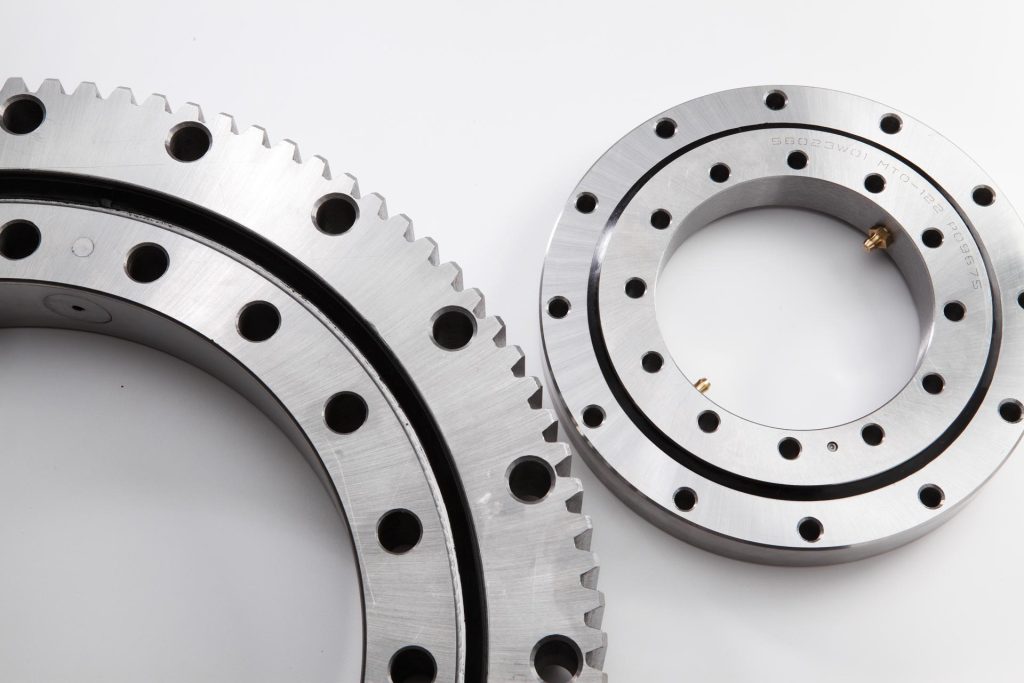
Why UK Heavy Industries Are Racing to Secure Slewing Ring Bearings
Britain's offshore wind expansion, defence manufacturing surge, and healthcare modernisation programme are converging to create extraordinary pressure on slewing ring bearing supply chains. These large-diameter precision components, essential for everything from turbine yaw systems to radar installations and MRI scanners, now face lead times stretching beyond six months as manufacturers struggle to keep pace with demand across multiple high-growth sectors. The Bearing Specialists has worked alongside procurement engineers, OEM designers, and project managers across these sectors, providing first-hand insight into how this supply pressure is reshaping industrial procurement decisions across the UK.
The numbers tell a stark story. The UK currently operates 15.9 gigawatts of offshore wind capacity, yet government targets call for reaching 43 to 50 gigawatts by 2030. Every new turbine requires multiple slewing ring bearings for pitch and yaw control systems, with offshore installations demanding components engineered to withstand decades of salt spray, constant vibration, and extreme temperature swings. Simultaneously, defence manufacturers are scaling production to meet the largest sustained spending increase since the Cold War, while the NHS pushes to establish community diagnostic centres requiring precision imaging equipment across England.
This collision of demand signals isn't theoretical. UK bearing specialists report order backlogs unlike anything seen in recent decades, with some custom slewing ring specifications requiring 28 weeks or more for delivery. The squeeze affects manufacturers across wind energy, defence, and medical imaging, forcing procurement teams to rethink just-in-time strategies that now carry unacceptable risk.
The Offshore Wind Acceleration
Britain has built an entirely new energy sector over 25 years, growing from a few demonstration turbines to the world's second-largest installed offshore capacity. According to The Crown Estate's 2024 Offshore Wind Report, UK offshore wind now comprises 15.9 gigawatts of grid-connected capacity capable of powering more than half of UK homes, with a strong pipeline of 95 gigawatts working through planning, consenting, and construction phases.
How Many Bearings Does an Offshore Wind Turbine Actually Need?
Each offshore turbine requires between 13 and 20 bearings, depending on design specifications, with slewing rings handling the critical yaw and pitch functions that optimise energy capture. Yaw bearings allow the entire nacelle assembly to rotate and face into the wind, while pitch bearings adjust individual blade angles for efficiency and storm protection. These aren't commodity components. Offshore slewing bearings must handle combined axial, radial, and moment loads while operating reliably for 25-year service lives in corrosive marine environments. Understanding the difference between yaw bearing and pitch bearing wind turbine applications is essential for procurement teams, as each component faces entirely different load profiles and failure modes despite sitting within the same turbine assembly.
The push toward larger turbines compounds bearing complexity. Modern offshore installations now routinely exceed 8 megawatts, with 15-megawatt designs entering production. Larger rotors demand proportionally larger bearings with tighter tolerances and more sophisticated sealing arrangements for harsh environments. Industry data indicates slewing ring bearings dominate wind turbine installations, accounting for approximately 63 percent of total bearing market share in this sector.
Understanding how bearing selection affects operational outcomes, particularly which specifications match specific turbine applications, proves essential for procurement teams navigating this expanding market. Wind Turbine Slewing Bearings: How UK Offshore Expansion Creates New Engineering Challenges examines these technical considerations in depth.

Defence Manufacturing Renaissance
The UK Defence Industrial Strategy 2025 explicitly positions defence manufacturing as an economic growth engine, backed by spending commitments reaching 2.5 percent of GDP by 2027, with ambitions toward 3 percent. The strategy describes how government and industry will combine around priority outcomes, including backing UK-based businesses, positioning Britain at the leading edge of defence innovation, and developing a resilient industrial base.
Ministry of Defence expenditure with industry reached £28.8 billion in 2023/24, supporting over 200,000 jobs across the UK, with nearly 70 percent of spending occurring outside London and the South East. The government announced £250 million for regional Defence Growth Deals in Plymouth, South Yorkshire, Northern Ireland, Scotland, and Wales to create jobs and support innovation. Defence slewing bearings are required across multiple applications, including radar systems, naval gun mounts, vehicle turrets, and satellite tracking equipment. Our aerospace bearing tools and bearing installation solutions are used by teams working within the defence supply chain, where handling precision is as critical as the bearing specification itself.
UK Defence Industrial Strategy: What It Means for Bearing Supply Chain Resilience
Naval and coastal defence systems present particular challenges. Bearings must function reliably in salt-laden atmospheres while handling the dynamic loads generated by shipboard motion or coastal weather exposure. Radar antenna systems require smooth, backlash-free rotation with positioning accuracy measured in arc-seconds. These specifications demand specialised materials, advanced sealing technologies, and manufacturing precision that few global suppliers can consistently deliver.
The strategic importance of bearing supply chain resilience hasn't escaped government attention. The Defence Industrial Strategy explicitly addresses supply chain resilience, calling for stockpiles of critical components and reduced dependence on foreign suppliers for essential manufacturing inputs. UK defence slewing ring bearing procurement increasingly requires UK-based suppliers who understand the Ministry of Defence's quality requirements and can maintain the security clearances necessary for sensitive programmes. For organisations operating in the nuclear and high-security sectors, our dedicated nuclear sector page covers the specialist bearing specifications these environments require.
Medical Imaging Equipment Demand
NHS Community Diagnostic Centres: How Bearing Demand Is Reshaping Medical Procurement
NHS diagnostic imaging faces its own capacity challenge. Approximately 45 million imaging tests occur annually in England, with MRI examinations representing roughly 33 percent of total activity according to NHS England statistics. The Department of Health and Social Care launched a national plan establishing over 160 community diagnostic centres across England, decentralising imaging services that previously required hospital attendance. Each new facility requires MRI scanners, CT systems, and other imaging equipment incorporating precision slewing bearings. This rapid deployment of new imaging infrastructure has fundamentally changed the procurement horizon for medical-grade bearings, with NHS supply chains now competing directly with defence and wind energy for finite manufacturing capacity.
MRI scanners present unique bearing requirements. Patient tables must move smoothly through scanner bores with micron-level positioning accuracy while avoiding any magnetic interference with imaging fields. This demands non-magnetic materials, including certain stainless steel grades and ceramic rolling elements that standard industrial bearings cannot provide. The UK imaging services market continues to expand, driven by rising chronic disease prevalence and technological advancement in diagnostic equipment. Our medical sector page covers the full range of bearing solutions we supply for healthcare diagnostic equipment, including MRI-compatible and non-magnetic specifications.
Private healthcare providers are expanding imaging capabilities alongside NHS investment, driven by waiting list pressures and growing demand for rapid diagnostics. Mobile MRI units now serve rural communities previously requiring long journeys to regional hospitals. These mobile installations demand bearings engineered for transport stresses and rapid setup while maintaining the positioning precision diagnostic imaging requires.
The convergence of NHS modernisation with private sector expansion creates sustained demand for medical-grade bearings that manufacturers struggle to satisfy alongside wind energy and defence requirements. Custom slewing bearing lead times for specialised non-magnetic bearings have extended significantly, forcing equipment manufacturers to commit orders further in advance than traditional procurement practices allowed. Understanding how specialised applications shape bearing specifications, as explored in Non-Magnetic Slewing Bearings: Meeting Defence and Medical Sector Precision Requirements, helps procurement teams navigate these technical distinctions.
Supply Chain Pressures and Lead Times
Why Are Slewing Ring Bearing Lead Times So Long in the UK?
The global slewing bearing market was valued at approximately USD 4.3 billion in 2023 and projects growth toward USD 7.2 billion by 2033, representing a compound annual growth rate exceeding 5 percent. This growth creates manufacturing capacity constraints as bearing producers worldwide struggle to expand production quickly enough to match demand. Steel price volatility, skilled workforce shortages, and the technical complexity of large-diameter precision bearing production all contribute to extended lead times that show few signs of improvement.
Custom slewing ring specifications face the longest waits. Bearings requiring non-standard materials for marine corrosion resistance, unusual mounting configurations for retrofit applications, or specialised sealing arrangements for harsh environments may require six months or longer from order placement to delivery. This timeline forces manufacturers in wind, defence, and medical sectors to forecast requirements far earlier than they historically preferred, accepting inventory carrying costs as preferable to production delays. A sound bearing procurement strategy for long lead time components now typically means planning twelve months or more ahead for custom specifications, and maintaining buffer stock agreements with technically qualified UK suppliers.
UK bearing specialists report growing demand for comprehensive application engineering that goes beyond simple component supply. Customers increasingly require technical consultation addressing mounting surface preparation, lubricant selection for specific operating environments, and long-term maintenance planning. This consultative approach helps customers select specifications appropriate for actual operating conditions, avoiding both over-engineering costs and premature failure risks. Our oil and gas sector page illustrates how similar procurement challenges in another harsh-environment industry are addressed through early supplier engagement and careful specification development.
The supply pressure shows no immediate relief. Wind energy targets remain aggressive, defence spending continues increasing, and healthcare diagnostic capacity requires ongoing expansion. Bearing manufacturers face difficult decisions about capacity investment while customers adapt procurement strategies to longer planning horizons. Those securing reliable supply relationships with technically capable specialists gain a competitive advantage in project execution and operational reliability.

Engineering Specifications That Matter
How to Select the Right Slewing Ring Bearing for Your Application
Slewing ring selection demands careful attention to actual operating requirements rather than generic specifications copied from previous projects. Load calculations must account for combined radial, axial, and moment forces that vary significantly across applications. A wind turbine yaw bearing experiences continuous slow rotation under massive moment loads, while a radar antenna bearing requires rapid acceleration and precise positioning under lighter loads. Using specifications from one application in another invites premature failure or unnecessary cost. Four-point contact ball slewing bearings are the most common design for moderate-load applications requiring smooth rotation in both directions, while cross-roller slewing rings are better suited to applications demanding high rigidity and precise positioning accuracy — such as radar systems and precision industrial turntables.
Material selection proves equally critical. Standard bearing steels provide excellent performance in controlled industrial environments but fail rapidly when exposed to marine atmospheres, chemical contamination, or extreme temperatures. Slewing bearing material selection for marine environments typically favours austenitic stainless steel grades or coated steel with specialist sealing, balancing corrosion resistance against the load capacity penalties that non-ferrous materials carry. For applications within pharmaceutical and clean-room environments, our pharmaceutical page covers the material and lubrication specifications these regulated settings require, including PEEK retainer materials and food-grade lubricant compatibility.
Sealing arrangements distinguish bearings that survive harsh environments from those that fail prematurely. Offshore wind applications require multiple seal stages, preventing saltwater and abrasive particles from reaching raceways. Industrial applications may prioritise grease retention over contamination exclusion. Medical applications might require clean-room compatible materials and minimal particulate generation. Understanding which sealing arrangement matches which operating environment separates reliable performance from premature warranty claims. Our hybrid ceramic bearings and high temperature bearings address the more demanding end of this spectrum, where standard sealing and lubrication solutions are not viable.
Frequently Asked Questions About Slewing Ring Bearings in the UK Heavy Industry
Q1: What is a slewing ring bearing, and what is it used for?
A slewing ring bearing, also called a turntable bearing or slewing bearing, is a large-diameter precision component designed to carry combined axial, radial, and moment loads simultaneously while enabling controlled rotation. They are used in offshore wind turbines, radar installations, naval weapon systems, crane structures, MRI scanner mechanisms, excavators, and satellite tracking equipment, wherever a heavy structure must rotate smoothly and precisely under significant load.
Q2: Why are slewing ring bearing lead times so long in the UK right now?
Lead times for slewing ring bearings, particularly custom specifications, have extended to six months or beyond because UK and European manufacturing capacity is being simultaneously pulled by offshore wind expansion, defence production increases, and NHS diagnostic equipment programmes. Steel price volatility and skilled machinist shortages compound the problem. Procurement teams must now plan twelve months or more ahead for non-standard specifications.
Q3: How many slewing ring bearings does an offshore wind turbine require?
Depending on turbine design, an offshore wind turbine typically requires between 13 and 20 bearings in total. Slewing ring bearings specifically handle the yaw function — rotating the entire nacelle to face into the wind, and the pitch function for each blade, which adjusts blade angle to optimise power output and protect against storm conditions.
Q4: What is the difference between a yaw bearing and a pitch bearing on a wind turbine?
The yaw bearing sits beneath the nacelle and allows the whole rotor assembly to rotate horizontally, tracking wind direction changes throughout the day. Pitch bearings are located at the root of each blade and adjust the blade's angle relative to the wind. Yaw bearings handle larger, slower loads over continuous rotation, while pitch bearings experience oscillating loads and more frequent small adjustments — meaning each requires different specification priorities.
Q5: What materials are used in non-magnetic slewing bearings for MRI equipment?
Non-magnetic slewing bearings for MRI scanners and associated equipment typically use austenitic stainless steel grades such as 316L, titanium alloys, or engineering ceramics, including silicon nitride. These materials provide minimal magnetic permeability, preventing interference with the scanner's imaging field. Full ceramic or hybrid ceramic designs are specified for the most demanding bore-area applications where zero ferromagnetic content is essential.
Q6: Why does the UK Defence Industrial Strategy matter for bearing procurement?
The Defence Industrial Strategy 2025 explicitly calls for supply chain resilience and reduced dependence on foreign suppliers for critical components. For procurement teams, this means preference, and in some cases formal requirements, for UK-based bearing suppliers who hold appropriate quality certifications, understand Ministry of Defence standards, and can satisfy security requirements for sensitive programmes. It also signals sustained, long-term demand growth for specialised bearing components.
Q7: How should procurement teams handle long lead times for custom slewing ring bearings?
An effective bearing procurement strategy for long lead time components involves four key steps: forecasting demand twelve months or more ahead, maintaining buffer stock arrangements with qualified suppliers, engaging application engineering expertise early in the design phase to confirm specifications before committing to production, and avoiding single-source dependency for critical components where possible.
Q8: What causes slewing bearing failure in heavy industry applications?
The most common causes of slewing bearing failure in heavy industry are contamination of the raceway by water, abrasive particles, or chemical ingress; inadequate or incorrect lubrication; overloading beyond rated capacity; misalignment during installation; and fatigue from operating cycles that exceed design assumptions. In offshore and outdoor applications, seal degradation leading to raceway contamination is the dominant failure pathway, making sealing arrangement selection as important as load rating when specifying bearings.
The Bearing Specialists: Your Partner in Precision Solutions
The Bearing Specialists supply precision slewing ring bearings across the UK for defence, medical imaging, renewable energy, and automation and robotics applications. Our engineering team provides comprehensive application reviews addressing load calculations, bearing material selection, sealing arrangements, and maintenance planning for demanding operating environments. With direct experience supporting procurement teams across wind energy, UK defence supply chains, and NHS equipment programmes, we understand both the technical specifications and the commercial pressures that define bearing procurement in these sectors today.
Our Services Include:
Slewing Ring Bearings — Custom and standard bearings from 200mm to 5000mm+ diameter for wind energy, defence, medical imaging, and industrial applications
Technical Consulting — Application engineering, ensuring slewing ring specifications match actual operating requirements
Ready to Discuss Your Requirements? Contact The Bearing Specialists to arrange a proper application review with our engineering team.
Works Cited
"Offshore Wind Report 2024." The Crown Estate, 2024, www.thecrownestate.co.uk/our-business/marine/offshore-wind-report-2024. Accessed 29 Jan. 2026.
"Defence Industrial Strategy 2025: Making Defence an Engine for Growth." GOV.UK, Ministry of Defence, 8 Sept. 2025, www.gov.uk/government/publications/defence-industrial-strategy-2025-making-defence-an-engine-for-growth. Accessed 29 Jan. 2026.
Related Articles
- Wind Turbine Slewing Bearings: How UK Offshore Expansion Creates New Engineering Challenges
- Non-Magnetic Slewing Bearings: Meeting Defence and Medical Sector Precision Requirements