
The Bearing Specialists: Precision Engineering Excellence
When a production line stops unexpectedly in a modern UK factory, the financial damage compounds at a rate that would have been difficult to imagine even a decade ago. A 2026 survey of UK OEMs found that only three percent of manufacturers reported experiencing zero unexpected downtime events, while the majority experienced incidents quarterly or more frequently. More alarming still, many UK manufacturers report that a typical downtime event takes up to a week, and in some cases up to two weeks, to fully resolve. In an automated environment running around the clock to offset a workforce shortage of 48,000 unfilled positions, every hour of unplanned stoppage carries consequences that ripple from the factory floor to the customer delivery dock. The Bearing Specialists helps UK manufacturers eliminate these consequences at their root — through precision component specification that prevents the bearing and cam follower failures that most frequently initiate unplanned production stoppages.
The components that prevent these stoppages are not the ones that make headlines. Nobody writes press releases about cam followers, track rollers, or stator bearings. But when a cam follower seizes on a packaging line indexing at 200 cycles per minute, or a guide roller fails on a conveyor handling pharmaceutical product, the silence on the factory floor is deafening and expensive. Understanding why bearing failure causes production line downtime, and what the correct specification does to prevent it, is the most direct path from reactive maintenance to genuine manufacturing reliability.
The True Cost of Standing Still
How Much Does Unplanned Downtime Cost UK Manufacturers in 2026?
UK manufacturing output reached nearly £639 billion in 2025, marking the fifth consecutive year of growth. But that headline figure masks a persistent drag: unplanned downtime that erodes margins, delays deliveries, and undermines the productivity gains that automation investments are supposed to deliver. The UK government's Industrial Strategy identifies eight high-growth sectors with bespoke ten-year plans designed to attract investment, enable growth, and create high-quality jobs. Advanced manufacturing sits at the centre of this strategy, contributing over £82 billion in annual gross value added and supporting roughly 760,000 jobs directly.
The gap between this strategic ambition and operational reality is often measured in downtime minutes. Research consistently shows that unplanned stoppages in UK manufacturing are less frequent than in some other regions but significantly more disruptive when they occur, with resolution times stretching far beyond what automated, lean-inventory production environments can absorb without cascading consequences. A single extended downtime event can wipe out weeks of productivity gains captured through process improvement and automation investment.
The key financial impacts of unplanned manufacturing downtime include:
- Lost production output — automated lines running at hundreds of cycles per minute lose enormous volume within hours of stoppage
- Wages paid without corresponding production — maintenance technicians, quality engineers, and supervisors remain on payroll regardless of line status
- Emergency parts procurement costs — unplanned replacement sourcing carries significant price premiums over planned purchasing
- Cascading delivery penalties — customer SLA breaches from delayed shipments compound direct production losses
- Recommissioning labour — restarting, recalibrating, and quality-validating a stopped line is never a zero-cost exercise
Employment costs — the single largest risk facing UK manufacturers in 2026 — compound the downtime equation. When 86 percent of manufacturers expect employment costs to rise, every hour of idle machine time represents not just lost output but wages paid without corresponding production. Automated lines that promised to decouple production volume from headcount still require maintenance technicians, quality engineers, and supervisors on payroll regardless of whether the line is running.
Where Bearings and Cam Followers Enter the Equation
How Does Bearing Failure Cause Production Line Downtime?
Bearing and cam follower failures do not always register as the root cause in downtime reports. Maintenance teams often record the symptom, such as a seized conveyor, jammed indexer, or failed packaging station, rather than tracing the failure chain back to the specific component that initiated the stoppage. But experienced reliability engineers understand that a significant proportion of mechanical failures in automated systems originate at the bearing interface, where rolling elements, raceways, seals, and lubricants operate under conditions that leave no margin for specification error.
The most common bearing failure modes that cause production line downtime are:
- Raceway contamination — seal degradation allowing moisture, cleaning chemicals, or abrasive particles into the bearing, accelerating raceway wear
- Inadequate lubrication — wrong grease specification, depleted lubricant film, or incompatible lubricant-seal combinations causing metal-to-metal contact
- Overloading — dynamic or static loads exceeding the component's rated capacity, leading to surface fatigue and rolling element damage
- Brinelling — permanent indentation of the raceway from impact loads during indexing, caused by inadequate static load rating
- Misalignment — incorrect installation or thermal expansion differentials between metric and imperial components, creating edge loading on the raceway
- Fretting corrosion — small oscillatory movements under high contact stress in pitch bearing and cam follower applications, causing localised oxidative wear
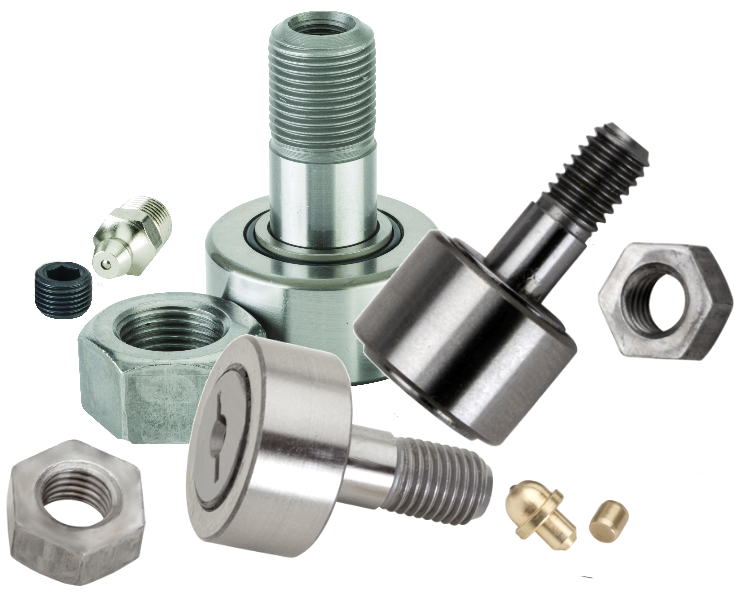
In cam-driven systems, which dominate packaging, food processing, and pharmaceutical manufacturing, the cam follower absorbs the full mechanical stress of converting rotary cam profiles into precise linear or oscillating motion. A cam follower operating correctly is invisible. A cam follower that has begun to degrade generates heat, vibration, and positional inaccuracy that propagate through the entire mechanism. By the time vibration sensors or quality control systems detect the deviation, internal damage may have progressed to a point where replacement is the only option — and the line must stop.
Signs a cam follower is failing in automated equipment include:
- Audible noise change — grinding, clicking, or rumbling sounds from previously silent motion systems
- Increased operating temperature — heat generation from degraded lubrication or rolling element damage
- Positional inaccuracy — deviation from the expected indexing position or linear stroke accuracy
- Vibration increase — measurable vibration signature change detectable via accelerometers or condition monitoring systems
- Lubricant contamination — discoloured or particle-laden grease expelled from bearing seals during operation
The factors accelerating cam follower degradation in modern UK manufacturing environments are well understood:
- Higher operating speeds demanded by automation investment
- Longer continuous run times driven by workforce constraints and lights-out production requirements
- More aggressive washdown chemicals required by food safety regulations
- Wider temperature ranges in facilities manage rising energy costs through reduced climate control
Each of these factors narrows the operating margin between a component performing within specification and one approaching failure. Understanding these failure accelerators is the foundation of effective cam follower specification — because each factor must be addressed in the component selection, not compensated for during maintenance.
The broader automation investment trends pushing these components harder than ever are examined in UK Factory Automation Market Surges Past £16 Billion, What It Means for Precision Motion Components, where the pace of factory modernisation creates new performance expectations for motion hardware.
Prevention Is an Engineering Decision, Not a Maintenance Budget Line
How to Prevent Cam Follower Failure: Correct Specification vs Reactive Replacement
The most effective defence against bearing-related downtime is not more frequent replacement schedules or larger spare parts inventories, though both have their place. It is a correct initial specification. The University of Sheffield Advanced Manufacturing Research Centre emphasises that innovation in competitive manufacturing sits at the intersection of productivity, quality, and workforce development, and the same principle applies at the component level. Getting the right cam follower into the right application from the outset eliminates the most common bearing failure modes before they have an opportunity to develop.
Correct cam follower specification for automated systems means:
- Matching seal type to the specific chemicals, temperatures, and ingress risks present in the facility, rather than selecting the standard seal on the catalogue page
- Validating dynamic load ratings against forces generated at maximum operating speed, not the machine's nameplate rating
- Verifying static load ratings against peak impact loads during indexing, not average running loads
- Confirming metric tolerance class matches housing and shaft specifications of the European-built equipment exactly
- Selecting cage material appropriate for the operating environment, including food-grade, stainless, or high-temperature variants where standard steel is inadequate
- Specifying lubricant compatibility with both the operating temperature range and any washdown chemicals that may contact the bearing externally
Manufacturers who invest in specialist bearing specification advice during the design and commissioning phase report:
- Measurably longer cam follower service intervals
- Fewer unplanned production stoppages
- Lower total maintenance spend over the equipment lifecycle
- Reduced emergency procurement costs from unplanned replacement events
The cost of expert specification is trivial relative to the cost of a single downtime event in an automated production environment. Our metric cam followers are application-engineered to address exactly these specification requirements — selected for actual operating conditions, not nominal catalogue ratings. For pharmaceutical sector applications where contamination control and full component traceability are mandatory, our pharmaceutical sector page details the specific bearing and cam follower grades required. For applications involving high operating temperatures that exceed standard grease and seal ratings, our high-temperature bearings address the thermal stability requirements that automated food processing and industrial environments increasingly impose.
The workforce dynamics amplifying these reliability stakes are detailed in 48,000 Manufacturing Vacancies Are Forcing UK Factories to Automate, And Precision Components Can't Keep Up, where the collision between automation urgency and component quality creates risks that many manufacturers are only beginning to recognise.
What Reliability-Focused Manufacturers Do Differently
How to Track Cam Follower Service Life and Build a Bearing Reliability Programme
Operations that achieve consistently low unplanned downtime rates share several practices. They engage specialist bearing suppliers before equipment is commissioned, not after the first failure. They maintain technical documentation linking specific cam followers and bearing specifications to individual machines, so replacement parts match original specifications exactly rather than relying on visual similarity or dimensional approximation. They track component service life against actual operating hours, building data sets that inform increasingly precise replacement timing.
The key practices of reliability-focused UK manufacturers include:
- Pre-commissioning specification review — engaging bearing engineers before equipment arrives, not after the first failure occurs
- Machine-level component documentation — maintaining a specification register linking each cam follower and bearing to the exact machine, position, and operating conditions it was selected for
- Operating-hours tracking — recording actual runtime against rated service life rather than relying on calendar-based replacement intervals that ignore actual duty cycles
- Like-for-like replacement discipline — verifying that replacement components match original specifications exactly, not just nominal dimensions
- Supplier-level quality assurance — requiring ISO 9001 certified supply chains with full material traceability for critical automated line components
They also recognise that not all metric cam followers are equivalent. Two components with identical catalogue dimensions may differ in:
- Raceway finish quality — affecting rolling element contact stress and fatigue life
- Roller crown geometry — determining edge load distribution under misalignment or deflection
- Cage material and design — influencing wear debris generation and lubricant retention
- Seal compound and geometry — determining ingress protection level across the operating temperature range
- Lubrication specification — affecting film thickness, corrosion protection, and thermal stability at operating speed
These differences become meaningful on automated equipment operating near rated capacity for extended periods. The cam follower that performs identically to a superior component during a one-hour test diverges dramatically over 5,000 hours of continuous high-speed operation. Our imperial cam followers support manufacturers operating mixed-specification environments where legacy imperial equipment runs alongside new metric-standard automated systems — ensuring like-for-like replacement discipline is maintained across both standards. For automation and robotics applications requiring compact precision motion components, our automation and robotics sector page covers the full range of bearing solutions we supply for UK factory automation environments. Where bearing reverse engineering is required for obsolete or non-standard machines, our engineering team provides expert analysis to identify and source compliant replacement specifications that match original performance requirements. Our angular contact bearings and hybrid ceramic bearings extend this capability to the most demanding high-speed and clean-room automation applications.
The manufacturers capturing the greatest value from the UK's automation investment wave are those treating precision component selection as a strategic decision with direct financial consequences, not a procurement checkbox to be completed at the lowest price.

Frequently Asked Questions: Unplanned Downtime and Precision Bearings in UK Manufacturing
Q1: How much does unplanned downtime cost UK manufacturers?
UK manufacturers face substantial financial losses from unplanned downtime that compounds across multiple cost categories simultaneously. Direct losses include lost production output, wages paid without corresponding production, and emergency spare parts at premium procurement prices. Indirect losses include customer SLA penalties, recommissioning labour, quality revalidation costs, and reputational damage from delivery failures. Industry research indicates that a single extended downtime event — taking one to two weeks to fully resolve, as many UK OEMs report — can eliminate weeks of productivity gains from process improvement and automation investment combined. In automated environments designed to run continuously without operator intervention, the per-hour cost of stoppage is significantly higher than in manually operated equivalents.
Q2: What causes bearing failure in automated production lines?
The most common causes of bearing failure in automated production lines are: raceway contamination from seal degradation allowing moisture or abrasive particles to ingress; inadequate or incorrect lubrication causing lubricant film breakdown and metal-to-metal contact; overloading beyond the component's dynamic or static rated capacity; brinelling from impact loads during indexing that exceed the static load rating; misalignment creating edge loading on raceways; and fretting corrosion in oscillating contact applications. In modern automated environments, all six failure modes are intensified by higher speeds, longer continuous run times, aggressive washdown chemicals, and wider temperature ranges compared to previous-generation manufacturing equipment.
Q3: How do cam followers cause unplanned production line downtime?
Cam followers are the primary motion transmission component in cam-driven automated systems, including packaging indexers, pharmaceutical filling machinery, and food processing conveyors. When a cam follower begins to degrade, it generates heat, vibration, and positional inaccuracy that propagate through the entire mechanism. Because these early degradation signals are often below detection thresholds until damage has advanced significantly, the line frequently continues running until the cam follower fails — at which point the line stops without warning. Early detection through condition monitoring, or elimination of the failure through correct initial specification, are the two effective preventive strategies.
Q4: Why is unplanned downtime more costly in automated factories?
Automated production lines are more vulnerable to downtime cost escalation than manually operated equivalents for three structural reasons. First, automated lines run at higher speeds and continuous cycle rates, meaning more output is lost per hour of stoppage. Second, automated lines are designed without the operator flexibility that allows manual processes to route around a failed station — one component failure can halt the entire line. Third, automated lines require specialist maintenance technicians to diagnose and resolve failures, and those technicians command higher employment costs and are in shorter supply than general factory operatives, extending resolution times and increasing labour costs per downtime event.
Q5: What is the difference between planned and unplanned bearing maintenance?
Planned bearing maintenance involves scheduled inspection, lubrication, and replacement at intervals determined by operating hours or condition monitoring data, carried out during planned production stoppages or maintenance windows. Unplanned bearing maintenance occurs in response to unexpected failure, requiring immediate production stoppage, emergency parts procurement, and unscheduled maintenance labour. The financial difference between the two is substantial: planned replacement of a cam follower on schedule might cost £50 to £500 in parts and labour. Unplanned replacement of the same component after failure on an automated line can cost tens of thousands of pounds in lost production, emergency sourcing premiums, and overtime maintenance labour — before accounting for customer penalties.
Q6: How do I specify cam followers correctly for a high-speed automated system?
Correct cam follower specification for high-speed automated systems requires six inputs that catalogue browsing cannot provide: the actual dynamic load at maximum operating speed (not the nominal machine rating), the peak static load during indexing or impact events, the specific operating environment including temperature range and chemical exposure, the required seal type for ingress protection, the tolerance class matching the housing and shaft of the host machine, and the cage material appropriate for hygiene, temperature, or contamination requirements. Each of these inputs must be matched to the cam follower's rated properties — not assumed from dimensional similarity to a previously used component.
Q7: What is bearing reverse engineering, and when is it needed?
Bearing reverse engineering is the process of identifying the complete specification of a bearing or cam follower installed in a machine where the original specification documentation is unavailable — common in older equipment, machines with discontinued components, or installations where specification records were never created or have been lost. The process involves dimensional measurement, material analysis, seal identification, and comparison against current manufacturer catalogues to identify a compatible replacement that meets or exceeds the original specification. It is needed whenever a like-for-like replacement cannot be sourced from the original part number, which becomes increasingly common as machinery ages and original suppliers discontinue specific configurations.
Q8: How does an ISO 9001 certified bearing supplier reduce manufacturing downtime?
An ISO 9001:2015 certified bearing supplier provides quality management system assurance that affects downtime risk in several ways. Product traceability from raw material through to delivered bearing ensures that components meet stated specifications and that any non-conformance can be identified and isolated quickly. Documented inspection and testing procedures verify dimensional and material compliance before dispatch, reducing the risk of out-of-specification components reaching the production floor. Application engineering capability within a certified quality framework means specification recommendations are based on documented analysis of operating conditions rather than catalogue matching, reducing the probability of initial specification errors that cause premature bearing failure.
The Bearing Specialists: Precision Components for Automated Manufacturing
At The Bearing Specialists, we help UK manufacturers eliminate bearing-related downtime through correct component specification, application-matched product selection, and technical guidance grounded in decades of engineering experience. Our ISO 9001:2015 certified team works with manufacturers across pharmaceutical, food processing, packaging, automotive, and industrial sectors. Every specification recommendation we make begins with understanding your actual operating conditions — because the difference between a component that lasts 2,000 hours and one that lasts 8,000 hours on the same machine is almost always a specification decision made before the component was ordered, not a maintenance decision made after it was installed.
Our Services Include:
Metric Cam Followers — Application-engineered cam followers specified for actual operating conditions, including speed, load, temperature, and chemical exposure
Imperial Cam Followers — Inch-standard cam follower selection for mixed-specification and retrofit applications
Angular Contact Bearings — Combined axial and radial load capacity for servo-driven and high-speed automation applications
Hybrid Ceramic Bearings — Non-magnetic, low-particulate bearing solutions for clean-room and pharmaceutical environments
Bearing Specification and Reverse Engineering — Expert analysis matching precision components to automated system requirements for maximum service life
Ready to Eliminate Downtime at the Source? Contact The Bearing Specialists to discuss how the correct bearing specification can protect your automated production investment.
Works Cited
"Industrial Strategy Sector Plans." Department for Business and Trade, GOV.UK, 23 June 2025, www.gov.uk/government/publications/industrial-strategy-sector-plans. Accessed 25 Feb. 2026.
"Industrial Strategy Sets Out a Ten-Year Plan to 'Make Britain the Best Place to Do Business.'" University of Sheffield Advanced Manufacturing Research Centre, 23 June 2025, www.amrc.co.uk/news/industrial-strategy-ten-year-plan. Accessed 25 Feb. 2026.